
Color Strategy for Activewear Capsules: Managing Shade Control, MOQ, and Cross-Product Coordination
Color is no longer a finishing decision on a single women's activewear style. For growing brands building a capsule, color has become a development decision that affects fabric sourcing, shade control, minimum order quantity, and how a sports bra, leggings, and outer layer speak to each other in a coordinated line. Brands that treat color as a per-style decision often end up with a capsule that looks unrelated in photographs, dye-lot inconsistencies between the first and last bulk run, and a fabric MOQ that quietly doubles because colors were added one at a time.
This article walks through what growing brands should plan before sampling when a women's activewear capsule is built around a color story. It explains why color strategy now sits at the front of the development brief, how shade control is actually managed from lab dip to bulk production, how MOQ reacts to the number of colors in a capsule, how to build a capsule palette that coordinates across categories, and what to review during the sample stage when color is part of the spec. The aim is to help brands avoid color inconsistencies between styles, MOQ surprises, and the cross-product mismatch that comes from under-planning color at the capsule level.
Quick Answer
A women's activewear color capsule should be planned before sampling through three connected decisions: shade control across dye lots and fabric grades, minimum order quantity per color per style, and cross-product color coordination between sports bras, leggings, and outer layers. Growing brands often treat color as a per-style decision and discover the consequences only when the first bulk run arrives. Color strategy is a capsule-level development decision, and it should be reviewed through the same sample-stage gate as fit, fabric, and construction.
Table of Contents
- Who This Article Is For
- Why Color Strategy Is Now a Capsule Decision
- Shade Control: How Color Consistency Is Actually Managed
- MOQ and the Cost of a Wide Color Spread
- Building a Color Capsule Palette
- Cross-Product Color Coordination Across Categories
- Sample-Stage Color Review and the OEM/ODM Path
- Decision Check
- Manufacturer Insight
- FAQ
- Final Takeaway
Who This Article Is For
- Primary reader: Growing brand founders and product development leads planning a women's activewear capsule around a color story, with sports bras, leggings, shorts, tops, and outer layers that need to look coordinated.
- Secondary reader: Sourcing managers and private label buyers evaluating whether a base supplier can manage color consistency, dye lots, and MOQ across multiple colors in one capsule.
- Product stage: Early capsule planning or pre-sampling review, when the color palette and the number of colors per style are still open decisions.
- Problem being solved: How to plan a color capsule early enough to avoid shade inconsistency between styles, MOQ surprises, and cross-product color mismatch.
- Who may not need this article: Buyers with a fully confirmed tech pack that already specifies color per style, dye-lot approval, and color standards, or readers looking for consumer color-trend summaries.
What you gain from this article: A clearer framework for planning color at the capsule level, a way to identify the color decisions that cause the most sample revisions and MOQ surprises, and a sample-stage color review checklist that protects shade consistency from lab dip to bulk.
Why Color Strategy Is Now a Capsule Decision
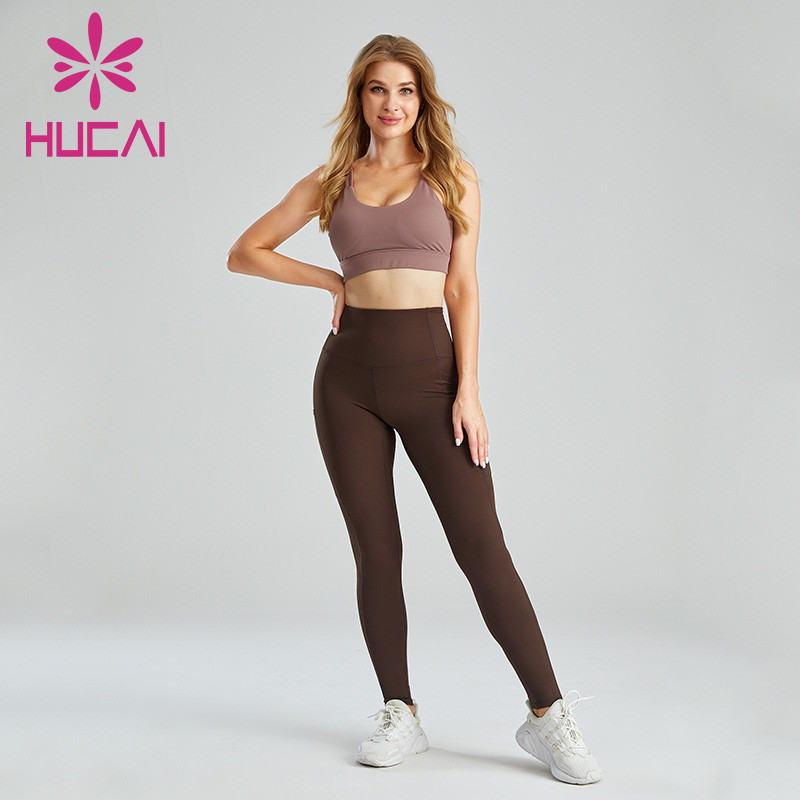
Five to ten years ago, most women's activewear launches were built style by style, with color added to each style on a per-SKU basis. The result was a catalog of strong individual styles that did not always look like a coordinated line. A black leggings and a black sports bra from the same brand could read as two different blacks, and seasonal colors rarely carried across the full range.
The market has shifted. Buyers increasingly evaluate a women's activewear brand by how its capsule looks together, not just by how each piece photographs alone. Color stories now appear across sports bras, leggings, shorts, tops, and light outer layers in the same drop. Capsule color planning has therefore moved from a marketing concern to a development concern, because the colors must be producible, repeatable, and consistent across fabric grades and product categories.
For growing brands, this shift has a practical consequence. Color now affects fabric sourcing, because not every color is available in every fabric grade. It affects MOQ, because fabric is often dyed per color and a wider color spread raises the per-color minimum. It affects sample rounds, because lab dips and color approvals become part of the development timeline. And it affects cross-product coordination, because a color that looks right on a leggings may read differently on a sports bra fabric with a different surface or stretch.
Treating color as a capsule decision means defining the color palette, the number of colors per style, the color standards, and the coordination rules before the first sample, not after. It also means linking the color spec to fabric, MOQ, and sample-stage review so each color decision can be checked against the next. For brands that have not yet redesigned their color workflow, the practical first step is to move color from the finishing spec into the development spec, alongside fit, fabric, and construction.
Shade Control: How Color Consistency Is Actually Managed
Shade control is the process of keeping the same color reading consistently from the lab dip, to the first bulk dye lot, to the last bulk dye lot, and across different fabric grades. It is the part of color strategy that growing brands most often underestimate, because the color looks correct in a single lab dip and then drifts in the bulk run.
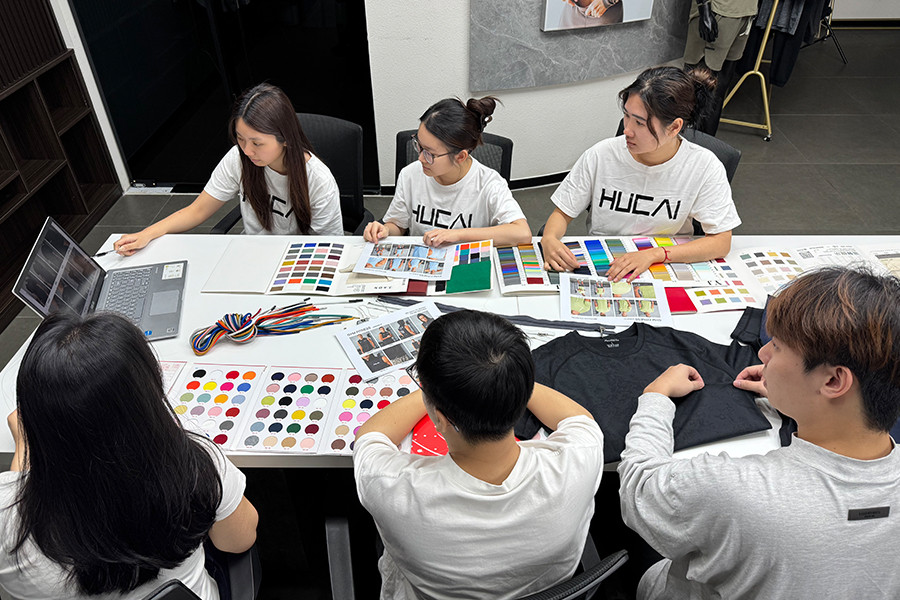
Lab dip and color standard. A lab dip is a small fabric sample dyed to the target color. It is reviewed under agreed lighting conditions against a physical or digital color standard, usually a Pantone reference or a previously approved fabric. The lab dip is the first color control point. If the lab dip is approved, the dye house uses it as the reference for the bulk run. If the lab dip is not approved, the lab dip cycle repeats before bulk production begins.
Bulk dye lot consistency. Even with an approved lab dip, the bulk dye lot can shift. Dye houses usually operate within a tolerance band, often expressed as a Delta E value against the standard. A small shift within tolerance is normally accepted. A larger shift causes a mismatch between the bulk fabric and the approved lab dip, which shows up in the finished garment. The risk increases when a capsule uses multiple colors, because each color has its own dye lot and its own tolerance window.
Cross-fabric grade consistency. The same color can read differently on different fabric grades. A matte nylon spandex used for leggings and a smoother polyester spandex used for a sports bra may produce different visual depth for the same color formula. A color that looks like a deep navy on the leggings fabric may look like a brighter navy on the sports bra fabric, even when both are within tolerance against the same standard. This is one of the most common causes of cross-product color mismatch in a capsule.
Pre-production color approval. Before bulk production, a pre-production color approval is conducted on the first bulk-fabric lot. The supplier cuts a small swatch from the bulk fabric, reviews it against the approved lab dip and the physical color standard, and confirms whether the bulk run can proceed. This step catches a dye-lot shift before the fabric is cut and sewn, and it is the most reliable place to manage shade risk. Skipping this step is one of the most common ways shade inconsistency reaches the finished garment.
Shade control is not a single step. It is a sequence: define a color standard, approve a lab dip, produce a bulk lot, and run a pre-production color approval. Brands that plan the sequence as part of the development brief, not as a finishing task, avoid most shade inconsistencies between styles and between dye lots.
MOQ and the Cost of a Wide Color Spread
Color count and minimum order quantity are tightly linked in women's activewear manufacturing, and the relationship is often the most expensive surprise in a first capsule. The link is driven by how fabric is dyed and how a production line is scheduled.
Fabric MOQ per color. Most fabric mills dye fabric in lots, and each dye lot has a minimum weight. A capsule that asks for a color across sports bras, leggings, and outer layers usually triggers a separate dye lot for that color per fabric grade. The fabric MOQ per color is therefore set by the dye-lot minimum, not by the per-style MOQ. A capsule with five colors in a single fabric grade may need to meet five separate dye-lot minimums, even when the per-style MOQ looks small.
Color spread vs. order efficiency. The wider the color spread, the higher the total fabric commitment. A capsule that runs four styles in eight colors commits to thirty-two fabric-color combinations, each of which must clear the dye-lot minimum. A capsule that runs four styles in three core colors plus one seasonal accent commits to a much smaller fabric commitment, and the per-color MOQ becomes easier to clear. The number of colors is therefore a strategic decision, not a marketing decoration.
Color consolidation and pre-orders. Growing brands often manage MOQ pressure by consolidating colors across the capsule. A deep navy, a charcoal, and a seasonal terracotta can serve as the capsule's three-color backbone, with two accent colors added only for the styles where the accent is most visible. Pre-orders and reorder forecasts can also reduce the per-color MOQ, because the dye-lot quantity can be split across the initial run and a planned reorder.
MOQ and trim color. Color decisions extend to trims, labels, elastics, and zips. A capsule that includes a contrast binding in a specific color adds another MOQ line. The trim MOQ is usually lower than the fabric MOQ, but it still affects the total order commitment, and it should be planned in the same conversation as the fabric color.
For brands building a first capsule, the practical rule is that the color spread should be planned before the style list is finalized. Adding a color after the first sample is almost always more expensive than choosing it at the capsule planning stage, because the dye-lot minimums, the trim minimums, and the production schedule have already been set.
Building a Color Capsule Palette
A color capsule palette is the small set of colors that the entire capsule is built around. It is not a list of every color the brand will ever use. It is the working set for one drop, usually three to six colors, chosen to coordinate across fabric grades, product categories, and seasonal timing.
Core colors, seasonal accents, and neutral bridges. A practical capsule palette usually combines a small set of core colors, a smaller set of seasonal accents, and one or two neutral bridges. Core colors carry across most styles and most seasons. Seasonal accents are the colors that change between drops, used in smaller quantities on the styles where they have the most visual impact. Neutral bridges, such as a deep charcoal, a warm taupe, or a soft off-white, are the colors that connect the core and the accent and prevent the capsule from reading as visually fragmented.
Color selection against fabric grade. Each color in the palette should be tested against the fabric grade it will be produced in. Some colors are easier to dye consistently on matte nylon spandex than on a smoother polyester spandex. Some accent colors look stronger on a small panel, like a contrast binding, than on a full leggings. The palette should be chosen with the fabric grade and the product structure in mind, not as a marketing exercise that happens before the development brief.
Color against product category. The same color can carry differently across sports bras, leggings, and outer layers. A deep navy reads as a strong neutral on a leggings but may feel heavy on a cropped sports bra. A bright seasonal color works on a sports bra panel or a leggings waistband, but may not be the right choice for a full outer layer. The palette should be reviewed against the full product mix, not just the dominant piece in the capsule.
Color and activity direction. Some colors carry stronger activity associations than others. A deep neutral palette often works well for studio and training categories. A brighter accent palette can work well for a seasonal capsule aimed at a specific market. The palette should be reviewed against the activity mix, the target market, and the season, not just against the style list.
For growing brands, a practical first capsule is usually three core colors plus one seasonal accent plus one neutral bridge. This gives a small enough color spread to manage MOQ and shade control, while still allowing a clear color story across the drop.
Cross-Product Color Coordination Across Categories
Cross-product color coordination is the part of color strategy that turns a list of styles into a capsule that looks like a single brand decision. It is also the part that is most often missed, because each style is usually reviewed on its own, and the cross-style check is treated as a marketing task instead of a development task.
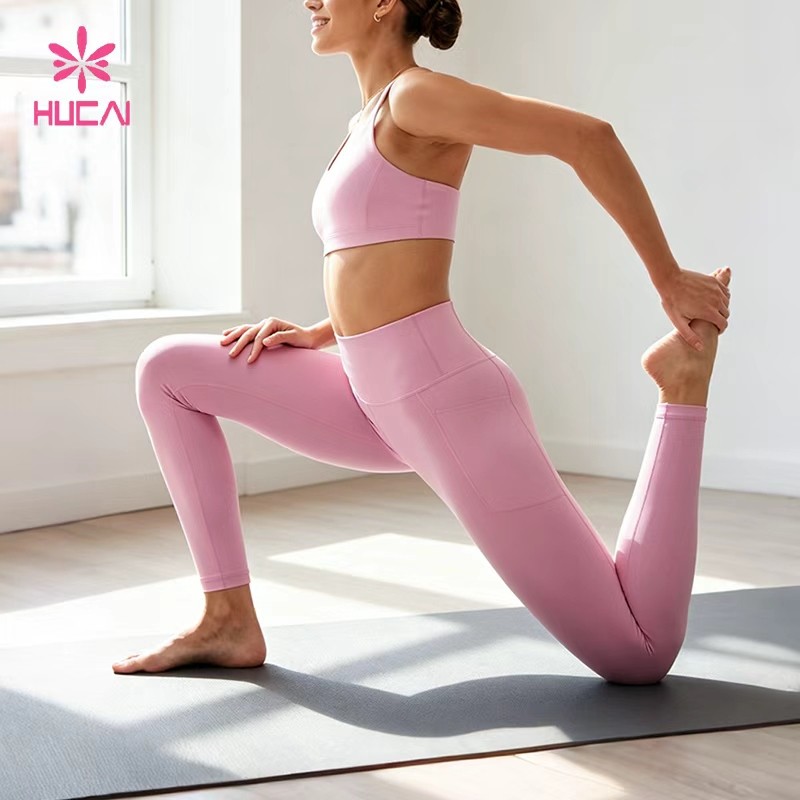
Matching set color logic. A matching set, such as a sports bra and leggings in the same color, is the most direct form of cross-product coordination. The set only works if the two pieces are cut from fabric that produces the same visual color in the same lighting, not just the same lab dip. This is why cross-fabric grade consistency is part of color strategy, not just part of quality control. The set should be reviewed as a set at the sample stage, not as two separate styles.
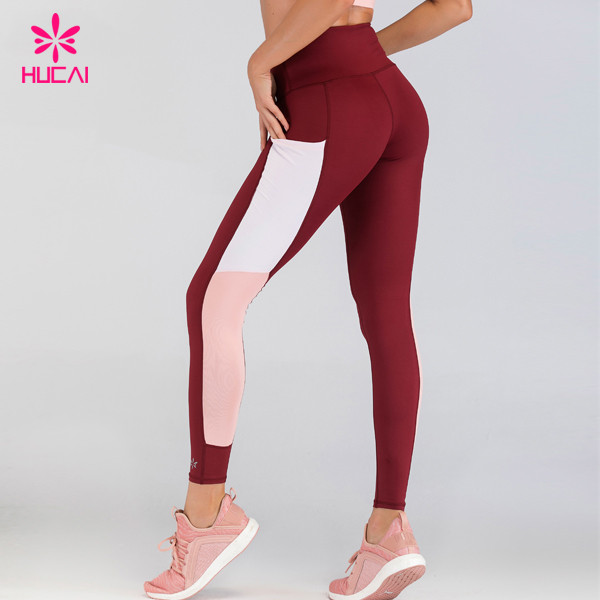
Coordination beyond the matching set. Most capsules include more than one matching set. The colors should coordinate across the full capsule, so a sports bra in color A, a leggings in color A, and a light outer layer in color A all read as the same color in the same photograph. Coordination is also about the contrast colors. A contrast binding on a sports bra and a contrast panel on a leggings should use the same color, and the binding and panel fabric should be reviewed for the same visual depth.
Color across fabric weights. A capsule often combines different fabric weights, such as a heavier compression fabric for leggings and a lighter fabric for a sports bra or a top. A color that looks correct on the heavier fabric may read as slightly different on the lighter fabric, because the surface texture, the stretch, and the dye uptake all change. The color spec should include the expected color shift across fabric weights, and the lab dip review should cover both weights where possible.
Color in photography and product pages. Cross-product color coordination also affects how the capsule looks on the website. A capsule where the colors drift slightly between styles will look inconsistent in product photography, even when the colors are technically within tolerance. The pre-production color approval and the cross-product sample review are the right places to catch this, not at the website photography stage.
Cross-product coordination is not a styling choice. It is a development decision that should be planned with the palette, the fabric grade, and the sample-stage review. Brands that treat it as a development decision, instead of a marketing decoration, produce capsules that look like a single line in product photography and on the rack.
Sample-Stage Color Review and the OEM/ODM Path
The right sample-stage color review depends on the development path the buyer is on. Color review is treated differently on an OEM project, where the buyer has defined the color, than on an ODM project, where the supplier is helping shape the color story.
OEM path. Buyers with a confirmed tech pack that already specifies the color, the color standard, the fabric grade, and the dye-lot approval process should review the lab dip and the bulk-fabric swatch against that specification. The lab dip is reviewed under the agreed lighting, the bulk-fabric swatch is reviewed against the approved lab dip, and the pre-production color approval is documented before bulk production begins. If the tech pack does not specify the color standard or the lab dip process, the OEM review should flag this as a gap before sampling, not after.
ODM path. Buyers starting from reference images, an early capsule concept, or a seasonal direction usually need color strategy support before sampling. The supplier reviews the color references, proposes a capsule palette, runs lab dips on the relevant fabric grades, and confirms the colors through a first sample. The first sample should be reviewed as a capsule, not style by style, so the cross-product color coordination is visible before the second sample round.
At HUCAI Sportswear, both paths are supported. For OEM projects, color review covers lab dip review, bulk-fabric swatch approval, pre-production color approval, and cross-fabric grade consistency against the confirmed spec. For ODM projects, color review covers capsule palette planning, fabric grade selection, lab dip review across the relevant fabric grades, and a capsule-level sample review before the second round. Sample development usually takes about 10-15 days, depending on style, fabric, color, trim, logo, revision requirements, and confirmed details. Bulk production often takes about 25-30 days after pre-production details and approvals are confirmed, including color approval, depending on project scope, materials, processes, quantity, and scheduling.
The current public MOQ starts from 100 pcs per style, while final color, size, fabric, trim, logo, and customization planning depends on the confirmed project. A wider color spread across the capsule may push the per-color fabric MOQ above the per-style minimum, and that should be planned before sampling.
Decision Check: Is the Color Capsule Ready for Sampling?
Before requesting samples, confirm the following:
- Capsule palette is defined: The number of colors in the capsule is set, with core colors, seasonal accents, and neutral bridges identified, and the palette is reviewed against the fabric grade and the product mix.
- Color standard and lab dip process are agreed: A color standard is documented for each color, the lab dip review lighting is set, and the lab dip approval process is part of the development timeline.
- MOQ per color is reviewed: The fabric MOQ per color is checked against the planned order, and the capsule is consolidated if the total fabric commitment is too high.
- Cross-fabric grade consistency is reviewed: Each color is checked against the fabric grades it will be produced in, and the expected color shift across fabric weights is documented.
- Cross-product coordination rules are set: The matching set, contrast trim, and cross-category color rules are documented, and the sample-stage review includes a capsule-level color check, not just a per-style check.
If four or five criteria are confirmed, the color capsule is ready for a structured sample request. If fewer than four are resolved, additional color planning will reduce sample revision cycles and protect shade consistency from lab dip to bulk.
Ready to move from color planning to sampling? Buyers with a tech pack that already specifies the color standard, the lab dip process, and the pre-production color approval can share the specification for OEM color review. Buyers starting from reference images or an early capsule color concept can discuss capsule palette planning and sample color priorities with HUCAI Sportswear before the first sample round.
Manufacturer Insight
A common early-stage issue in women's activewear color capsules is that brands select the palette from a screen or a single fabric swatch, then expect every other fabric grade to read the same color. A color that looks correct on a matte nylon spandex for leggings often reads slightly different on a smoother polyester spandex for a sports bra, and the difference is visible in product photography even when both fabrics are within tolerance against the same lab dip. The color capsule is more effectively resolved before sampling by treating the palette as a cross-fabric grade decision, not a single-fabric decision. When the color spec includes the expected color shift across fabric weights, the lab dip review covers each relevant grade, and the pre-production color approval is documented, the capsule stays coordinated from the first sample to the last bulk run.
FAQ
What is a color capsule in women's activewear?
A color capsule is the small set of colors that a women's activewear drop is built around. It usually combines core colors, one or two seasonal accents, and one or two neutral bridges, and it is reviewed against the fabric grade and the product mix. A practical first capsule is often three core colors plus one seasonal accent plus one neutral bridge.
How does shade control affect color consistency?
Shade control is the process of keeping the same color consistent from the lab dip to the first bulk dye lot to the last bulk dye lot, and across different fabric grades. It is managed through a color standard, an approved lab dip, a bulk-fabric swatch review, and a pre-production color approval before bulk production begins.
Does adding more colors to a capsule increase MOQ?
Yes. Most fabric mills dye fabric in lots, and each dye lot has a minimum weight. A wider color spread across the capsule usually triggers more dye lots, and the per-color fabric MOQ can push the total fabric commitment above the per-style minimum. Consolidating the palette before the style list is finalized is the most effective way to manage this.
What is a lab dip and why is it reviewed before sampling?
A lab dip is a small fabric sample dyed to the target color, reviewed under agreed lighting against a physical or digital color standard. It is the first color control point. If the lab dip is approved, the dye house uses it as the reference for the bulk run. Reviewing the lab dip before sampling confirms the color is producible on the relevant fabric grade and within tolerance against the standard.
How should color be coordinated across sports bras, leggings, and outer layers?
Color coordination across categories is a development decision, not a styling choice. The palette is reviewed against the fabric grade, the expected color shift across fabric weights is documented, the lab dip review covers each relevant fabric grade, and the sample-stage review includes a capsule-level color check. The matching set, contrast trim, and cross-category color rules are documented before the second sample round.
What is the MOQ for a women's activewear capsule with multiple colors?
The current public MOQ starts from 100 pcs per style. Final color, size, fabric, trim, logo, and packaging planning depends on the confirmed project. A wider color spread across the capsule may raise the per-color fabric MOQ above the per-style minimum, and that should be planned before sampling.
Should a buyer send color references or rely on the supplier for a color palette?
Buyers with a confirmed color standard, a Pantone reference, or a set of color references are usually better suited to OEM color review, where the supplier dyes to the spec. Buyers starting from a capsule concept or a seasonal direction often benefit from ODM color strategy support, where the supplier proposes a capsule palette, runs lab dips across the relevant fabric grades, and confirms the colors through a capsule-level sample review.
How long does color sampling usually take before bulk production?
Sample development usually takes about 10-15 days, depending on style, fabric, color, trim, logo, revision requirements, and confirmed details. A capsule that includes a lab dip review and a pre-production color approval may add a few days to the timeline. Bulk production often takes about 25-30 days after pre-production details and approvals are confirmed, including color approval, depending on project scope, materials, processes, quantity, and scheduling.
Final Takeaway
Color strategy for women's activewear capsules is a development decision, not a finishing decoration. It is resolved by defining the capsule palette against the fabric grade, setting the color standard and lab dip process, reviewing the per-color MOQ before the style list is finalized, documenting the expected color shift across fabric weights, and reviewing the capsule as a capsule at the sample stage. When the color spec is planned with the same depth as fit and fabric, shade consistency holds from lab dip to bulk and the capsule looks like a single line in product photography.
For buyers with a confirmed color standard, OEM color review covers lab dip approval, bulk-fabric swatch review, pre-production color approval, and cross-fabric grade consistency against the spec. For buyers with a capsule concept or a seasonal direction, ODM color strategy support covers capsule palette planning, lab dip review across the relevant fabric grades, and a capsule-level sample review before the second round. Either path benefits from a color brief that treats the palette as a cross-fabric grade decision from the first sample onward.
About HUCAI Sportswear
- Founded in 1998, specializing in women's activewear and sportswear manufacturing
- OEM and ODM development support for sports bras, leggings, shorts, tops, and matching sets
- Capsule-level color review covering lab dip approval, cross-fabric grade consistency, and pre-production color approval
- AQL 2.5-based inspection as part of the quality workflow
Current certification information can be reviewed during supplier evaluation based on the project and documentation requirements.
Recycled or certified material options can be reviewed based on project requirements and available documentation.