
Developing for Run, Train, Studio, and Court: How to Define Product Architecture Across Activities
Established activewear brands often reach a point where their product line spans multiple categories—running tights, training shorts, studio tops, and court skirts—yet the development logic behind each category still operates in silos. One team defines running product architecture one way, another approaches training with different assumptions about support, compression, and fabric recovery, and the studio or court line is developed almost as an afterthought. The result is not just operational inefficiency. Without a shared product architecture framework, brands accumulate redundant sample rounds, inconsistent fit standards across categories, and fabric portfolios that duplicate without adding real performance differentiation.
At HUCAI Sportswear, we work with established brands that are moving from category-by-category development toward a unified product architecture model. The question is not whether run, train, studio, and court can coexist in one brand portfolio—many successful brands already do this. The question is how to define the development variables that separate one activity category from another, so that each product has a clear reason to exist and sample-to-bulk processes remain predictable across the entire line.
Quick Answer
Defining product architecture across activities starts with mapping four variable layers—activity demand, support and compression targets, fabric recovery and opacity requirements, and construction and trim logic—against each category before a single sample is cut. Run products need recovery and chafe control as primary variables; training products prioritize multi-directional stretch and durability; studio products depend on soft hand feel and unrestricted range of motion; court products require structured support and opacity under dynamic movement. An established brand that defines these layers before sampling reduces cross-category redundancies, shortens the average number of revision cycles, and builds a fabric and construction library that supports both OEM and ODM development across the full portfolio.
Table of Contents
- Who This Article Is For
- Why Activity-Based Architecture Is Not the Same as Category Management
- The Four Variable Layers That Define Product Architecture
- Run: Recovery, Chafe Control, and Weather-Adaptive Detailing
- Train: Multi-Directional Stretch, Abrasion Resistance, and Compression Zoning
- Studio: Soft Hand Feel, Unrestricted Range of Motion, and Low-Profile Construction
- Court: Structured Support, Skirt-Short Systems, and Opacity Under Lateral Movement
- Decision Check
- Manufacturer Insight
- FAQ
- Final Takeaway
Who This Article Is For
- Primary reader: Established Brands with an existing multi-category activewear portfolio who are consolidating development processes across run, train, studio, and court lines
- Secondary reader: Growing Brands planning to expand from one or two categories into three or more activity-specific product lines
- Product stage: Pre-sampling architecture planning; brands that already have category-level product data and are now building a shared development framework
- Problem being solved: Redundant fabric portfolios, inconsistent fit and support standards across categories, unpredictable revision cycles, and difficulty explaining to factory partners why products that look similar have fundamentally different construction requirements
- Who may not need this article: Startup brands still developing their first single-category product line; brands sourcing only one activity type; buyers looking for consumer-level product comparisons rather than manufacturing architecture
What you gain from this article: A structured framework for defining how run, train, studio, and court products differ at the development variable level—not at the marketing level. You will understand which four variable layers matter most when briefing a manufacturer, how to avoid building redundant fabric libraries, and what to confirm before requesting samples across multiple activity categories.
Why Activity-Based Architecture Is Not the Same as Category Management
Category management typically organizes products by garment type: all sports bras in one group, all leggings in another. This approach works for e-commerce navigation and internal inventory, but it does not help a brand or manufacturer understand why a running legging needs different fabric recovery than a studio legging, or why a training sports bra requires a different underband structure than a court sports bra—even when both bras sit in the same category group.
Activity-based architecture starts from a different question: what does the body need from the garment during this specific activity, and how do those needs translate into fabric, support, compression, construction, and trim decisions?
When a brand briefs a manufacturer with only a category label—for example, “we need four leggings styles for the new collection”—the manufacturer has to infer activity intent from reference images or general assumptions. This creates risk. A legging developed with training assumptions but positioned for running may fail on recovery after repeated wash cycles. A sports bra developed with studio assumptions but used in a court collection may lack the underband stability needed for lateral movement.
Activity-based architecture removes this inference step. It tells the manufacturer: this product is for running, so recovery, chafe control, and reflective or weather-adaptive detailing are the priority variables. This product is for studio, so soft hand feel, unrestricted range of motion, and low-profile seam construction are the priority variables. The category label—sports bra, legging, short, top—becomes a secondary organizing layer, not the primary development driver.

The Four Variable Layers That Define Product Architecture
Before separating products by activity, establish the four variable layers that every product in the portfolio should reference. These layers create a consistent language between brand and manufacturer, and they make it possible to compare products across activities without relying on subjective descriptors.
Layer 1: Activity Demand. What physical movement pattern does the activity require? Running involves repetitive linear impact and forward propulsion. Training involves multi-directional movement, load-bearing, and ground contact. Studio involves sustained holds, inversions, and full-range joint articulation. Court involves lateral starts and stops, rotational movement, and short-burst acceleration. Each demand pattern creates different requirements for stretch direction, recovery, and seam placement.
Layer 2: Support and Compression Targets. Support targets should be defined by activity impact level and bust movement pattern, not by marketing preference. Compression targets should specify direction (circular, zonal, graduated) and intensity, and these targets must be reviewed against the fabric's actual stretch-recovery curve during sampling, not assumed from the fabric label.
Layer 3: Fabric Recovery, Opacity, and Surface Behavior. Recovery is the fabric's ability to return to its original dimensions after stretch—critical for running and court products where repeated movement cycles occur. Opacity must be evaluated under the specific movement patterns of each activity, not only under static fitting-room conditions. Surface behavior—whether the fabric is brushed, smooth, ribbed, or textured—affects both hand feel and the garment's interaction with other layers or equipment.
Layer 4: Construction and Trim Logic. Seam type, seam placement, stitch density, elastic selection, and trim attachment method should follow activity logic. A flatlock seam that works for studio may not hold up under the repeated stress of court lateral movement. A bonded hem that looks clean on a training short may fail on a running short subjected to thigh friction over distance. Trims should be specified by activity, not inherited from a general brand trim library.
Run: Recovery, Chafe Control, and Weather-Adaptive Detailing
Running product architecture should prioritize recovery as the primary variable. A running tight or short that loses shape after repeated wear cycles fails the product regardless of how it looks on a hanger. Recovery is not a marketing claim—it is a measurable fabric property that should be confirmed through elongation and recovery testing during the development phase.
Chafe control is the second architecture priority. Seam placement on running products should be evaluated against the repetitive motion path of the activity. Inner-thigh seams on running shorts, underarm seams on running tops, and underband seams on running bras are all high-risk zones. Flatlock or bonded seam construction in these zones reduces friction, but the specific construction choice should be tested on a wear sample, not assumed from a similar product developed for a different activity.
Weather-adaptive detailing—ventilation zones, reflective elements, thumbhole cuffs, zippered pockets—should be specified as part of the product architecture, not added as late-stage decoration. When these details are treated as afterthoughts, they create additional sample rounds and can introduce unexpected bulk or stiffness that contradicts the lightweight recovery requirement of the base garment.
For an established brand developing multiple running styles in one collection, the architecture should define which recovery standard applies across all running products so that a running tight, a running short, and a running bra can share a consistent performance baseline even when their construction details differ.
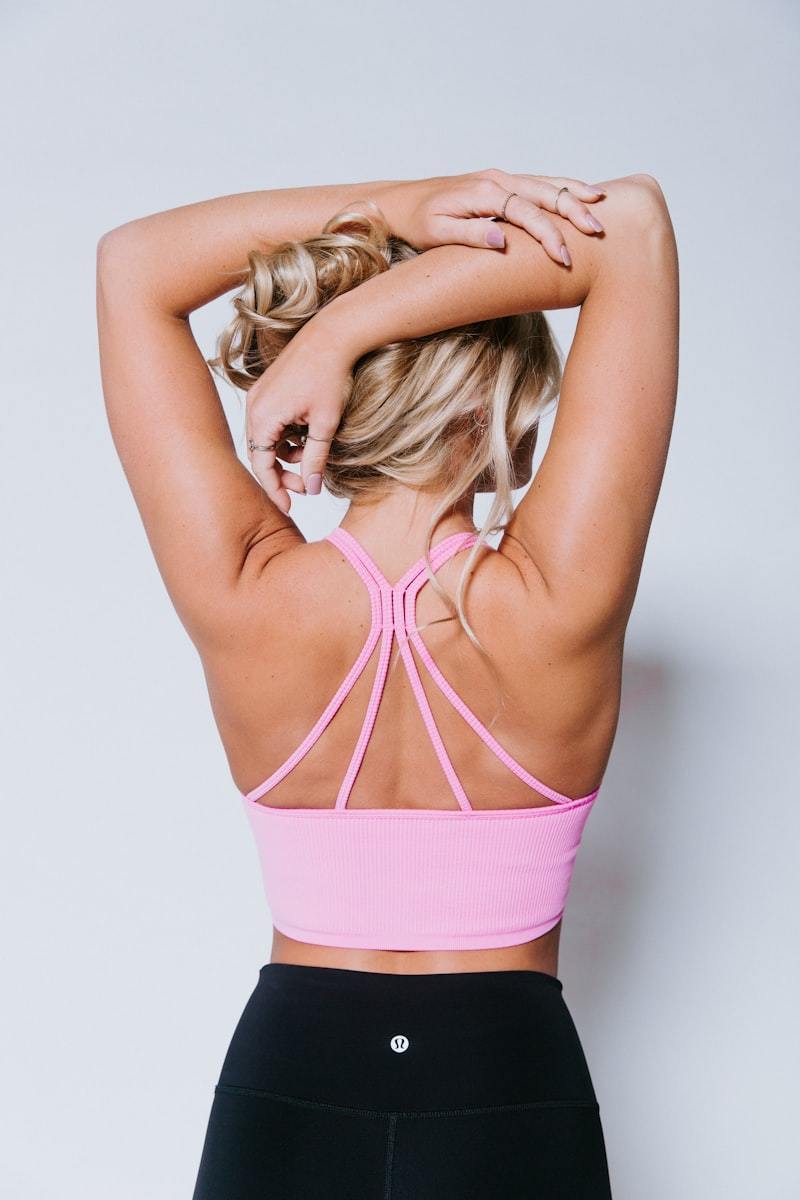
Train: Multi-Directional Stretch, Abrasion Resistance, and Compression Zoning
Training product architecture differs fundamentally from running architecture because the movement pattern is multi-directional rather than primarily linear. A training legging or short must accommodate squats, lunges, jumps, and floor work within a single session. This means stretch direction should be four-way, and recovery should be evaluated under multi-angle stress, not only linear elongation.
Abrasion resistance becomes a meaningful variable in training products because of contact with gym floors, mats, benches, and equipment. Fabric selection for training products should consider surface durability alongside hand feel. A fabric that feels soft and premium at the swatch stage may pill or abrade after repeated contact with textured gym surfaces. This is not a defect—it is a mismatch between fabric selection and activity architecture.
Compression zoning is a development variable that separates training products from studio products within the same brand portfolio. A training tight may benefit from graduated compression through the lower leg and targeted compression around the waistband, while a studio tight should prioritize unrestricted blood flow and comfort over compression intensity. The architecture should define compression direction and target zones per activity, then select fabric and panel construction accordingly.
Established brands often carry multiple training bottom styles—full-length tight, 7/8 tight, short, and bike short. The architecture should define which construction and fabric decisions are shared across all training bottoms (reducing MOQ fragmentation and fabric inventory) and which are style-specific (justified by a real functional difference). Without this logic, the brand ends up with four training bottoms that each use different fabrics and different construction standards, multiplying sample complexity without adding portfolio clarity.
Studio: Soft Hand Feel, Unrestricted Range of Motion, and Low-Profile Construction
Studio product architecture—covering yoga, Pilates, barre, and similar low-impact movement practices—is often the category where brands make the most fabric and construction assumptions. Because studio products are generally marketed as “comfort-first,” development teams sometimes treat fabric selection as secondary to color and silhouette. This creates products that look like studio wear but perform poorly during actual practice.
Soft hand feel is a legitimate architecture variable, but it must be balanced against opacity. A fabric that achieves an exceptionally soft surface through brushing or peaching may lose opacity under forward fold, downward dog, or seated straddle positions. Opacity requirements should be defined by the specific positions and movements of the intended activity, tested on a wear sample in natural and studio lighting, and confirmed before bulk fabric is ordered.
Unrestricted range of motion means that the garment should not resist the wearer's movement at any point in the activity's full range. For studio products, this means testing waistband behavior during forward folds, testing shoulder and armhole construction during overhead reaches, and testing leg opening behavior during deep lunges. A waistband that stays in place during walking may roll or dig during a Pilates hundred. Construction decisions—waistband height, elastic type, stitch tension—should be guided by these movement requirements.
Low-profile construction refers to the preference for minimal visible seams, clean edges, and smooth surfaces in studio products. This should be achieved through considered construction choices—bonded hems, clean-finish edges, flat interior seams—rather than through marketing language. When a brand requests “clean look” without specifying the construction method, the manufacturer may default to methods that compromise durability. The architecture should define which low-profile construction methods are acceptable for studio products and which are reserved for categories where durability is less critical.
Court: Structured Support, Skirt-Short Systems, and Opacity Under Lateral Movement
Court product architecture—covering tennis, padel, and similar racket sports—is the category that most often exposes gaps in a brand's existing development framework. Court products combine the support requirements of training with the opacity and recovery requirements of running, plus movement-specific construction demands that neither category fully addresses.
Structured support in court products means the garment must hold its position during lateral starts, stops, and direction changes. For court sports bras, this translates into wider underband construction, higher lateral support through the side panels, and strap configurations that resist slippage during overhead serves. The architecture should define support targets by bust size range and intended court activity intensity, not by comparing to a general “medium support” or “high support” label that may mean different things across categories.
Skirt-short systems present a unique architecture challenge. The outer skirt layer and inner short layer have different functional requirements but must work as a single system. The outer skirt needs drape, opacity under movement, and hem behavior that does not interfere with leg drive. The inner short needs compression, moisture management, pocket functionality for balls, and leg-grip stability to prevent riding up during lateral movement. Developing these as separate products and pairing them at the styling stage often creates fit incompatibility. The architecture should treat the skirt-short as one system with coordinated specifications.
Opacity under lateral movement is a critical variable for court bottoms. A fabric that passes a static opacity check may become translucent during a deep lateral lunge when stretched across the hip and thigh. Opacity evaluation for court products should include dynamic testing under the specific movement patterns of the sport, in the lighting conditions where the product will be worn. This is not an area where assumptions from other categories can safely transfer.
Decision Check: Is Your Product Architecture Ready for Cross-Category Sampling?
Before requesting samples across multiple activity categories, confirm the following:
- Activity demand map: Each product category has a documented movement pattern, impact level, and primary physical stress that the garment must accommodate
- Variable layer alignment: Support targets, compression direction, fabric recovery, opacity, and construction logic are defined per activity category and documented in a shared brief that the manufacturer can reference
- Fabric portfolio audit: No two activity categories share the same fabric without a documented performance reason; redundant fabrics have been identified and consolidated
- Cross-category consistency: Where two categories genuinely share a performance requirement (for example, opacity under stretch for both running and court), the same test standard is applied across both
- Sample review criteria: Each activity category has defined pass/fail criteria for the sample review stage, based on the architecture variables, not on subjective hand feel or visual preference alone
If three or more criteria are confirmed, the architecture is ready for a structured sample request. If fewer than three are resolved, investing additional time in architecture documentation before sampling will reduce revision cycles, control development cost, and produce a more coherent product line.
Ready to Define Your Product Architecture?
If your brand has existing product data across two or more activity categories and you want to build a shared architecture framework, share your current category specifications and activity direction for ODM development review. If you have a complete architecture brief with confirmed fabric and construction direction across categories, send your tech pack for OEM review.
Manufacturer Insight
One of the most common issues we see when established brands bring a multi-category architecture brief to sampling is what we call “inherited construction.” A brand develops a successful training legging with a specific waistband construction, then applies that same waistband to a court skirt-short system without re-evaluating it for lateral movement. The waistband works for training because the primary stress is vertical (squat, lunge). But on a court, lateral lunges apply force in a direction the waistband was never designed to resist. The result is not a manufacturing defect—it is an architecture gap. The fix is not to change the factory or the fabric. The fix is to define waistband construction requirements per activity category at the architecture stage, before the first sample is cut. This single change in development sequence—defining construction logic by activity demand rather than inheriting it from a previous successful style—is one of the highest-impact improvements an established brand can make to its multi-category development process.
FAQ
What is the difference between category management and activity-based product architecture?
Category management groups products by garment type—all sports bras together, all leggings together. Activity-based architecture groups development decisions by what the body needs from the garment during a specific activity, then applies those decisions to each garment type within that activity group. The two approaches are complementary, but architecture should drive development decisions while category management supports navigation and inventory.
Should every product in a brand portfolio be assigned to exactly one activity category?
Not necessarily. Some products genuinely serve multiple activities—for example, a training tight may also be used for studio practice. In these cases, the architecture should identify the primary intended activity and define construction accordingly. If a product is explicitly designed for cross-activity use, the architecture should state which activity's requirements take priority for each variable layer: support from training, hand feel from studio, recovery from running, and so on. Without this prioritization, the product risks meeting no activity's requirements fully.
How many fabric qualities should an established brand maintain across four activity categories?
There is no fixed number, but a practical target is two to four core fabric platforms, each with a defined performance profile, plus activity-specific variations where genuinely needed. A running fabric platform and a studio fabric platform may differ fundamentally in recovery and hand feel, and that difference is justified. But carrying eight fabrics across four categories, where several fabrics overlap in performance profile, usually indicates that fabric selection has been led by individual style development rather than portfolio-level architecture planning.
Can the same sports bra construction work for both training and court?
It can, but only if the architecture explicitly confirms that the underband stability, lateral support, and strap configuration meet the requirements of court movement patterns. A training bra developed for vertical impact (jumping, running in place) may not provide enough lateral stability for tennis serves and side-to-side movement. Rather than assuming compatibility, test the construction against the more demanding activity's requirements. If it passes, document the dual-use decision. If it does not, develop a court-specific construction.
What should an established brand prepare before briefing a manufacturer for multi-category product architecture?
At minimum, the brand should provide: a document mapping each activity category to its movement pattern, impact level, and primary physical stress; current fabric specifications or fabric direction for each category; support and compression targets by category and product type; any existing fit standards or measurement charts per category; and a clear statement of which categories are ready for sampling and which are still in early planning. Starting with this package allows the manufacturer to provide category-specific development recommendations rather than working from general assumptions.
How does MOQ planning work when a brand is developing across four activity categories?
The current public MOQ starts from 100 pcs per style. When developing across multiple categories, MOQ planning should consider how color, size range, fabric, trim, and logo requirements distribute across each category. Consolidating fabric platforms across categories where performance requirements align can help manage MOQ thresholds. The final MOQ plan depends on the confirmed project scope, including per-category style count, per-style color and size distribution, and customization level.
How long does sample development usually take for a multi-category collection?
Sample development usually takes about 10-15 days per style, depending on style complexity, fabric and trim availability, logo requirements, and revision needs. For a multi-category collection, sample timing should be planned category by category, with the understanding that categories requiring new fabric development or complex construction may extend the timeline. The total sample phase timeline is confirmed after the full project scope and per-category requirements are reviewed.
What affects sample-to-bulk consistency across different activity categories?
Sample-to-bulk consistency depends on confirmed standards, approved samples, material control, in-process review, and final inspection. Across multiple activity categories, additional variables include: whether each category uses the same or different fabric platforms, whether construction standards are documented consistently across categories, and whether the approved sample for each category captures the full specification set. Categories with more complex construction or specialized trims may require additional in-process review points.
Final Takeaway
Activity-based product architecture is not about creating more categories. It is about creating a shared development language that makes each category's requirements visible, comparable, and manufacturable. Established brands that define architecture before sampling reduce redundant fabric portfolios, shorten revision cycles, and give their manufacturing partners a clear brief that separates genuine functional differences from inherited assumptions. The four variable layers—activity demand, support and compression targets, fabric recovery and opacity, and construction and trim logic—provide a framework that works across run, train, studio, and court without forcing every category into the same mold. Start with the activity that has the most complete product data, define its architecture variables, then use that template to audit and align the remaining categories. The result is a product line where every style has a documented reason to exist, and every development decision traces back to the activity the product was built for.
About HUCAI Sportswear
- Founded in 1998, specializing in women's activewear and sportswear manufacturing
- OEM and ODM development support for sports bras, leggings, shorts, tops, and matching sets across run, train, studio, and court categories
- Structured sample development with activity-specific review criteria and sample-to-bulk consistency control
- AQL 2.5-based inspection as part of a coordinated quality workflow covering pre-production review through final inspection
Current certification information can be reviewed during supplier evaluation based on the project and documentation requirements. Recycled or certified material options can be reviewed based on project requirements.