Garment Stability in Women's Activewear: Why Leggings Slide Down
Why Leggings Sliding Down Is So Common
Many women experience the same issue with leggings during exercise. Whether running, squatting, or transitioning between yoga poses, leggings that initially feel well fitted can gradually start to slide down.
The common assumption is that the waistband is too loose or the size is incorrect. However, many properly sized leggings still experience this problem during movement.
In most cases, the real cause is garment stability.
Garment stability refers to the ability of clothing to remain aligned with the body while the body moves. In women's activewear , this stability is influenced by how fabric tension, body movement, and garment structure interact during activity.
When tension across the garment becomes unbalanced, the leggings gradually move toward the direction of least resistance, which often results in downward sliding.
Body Shape Changes During Movement
One reason leggings lose stability is that the human body does not maintain a fixed shape during exercise.
When bending, squatting, or stretching, the relationship between the waist and hips changes significantly. Research in clothing ergonomics shows that body surface dimensions in the hip and torso region can change by roughly 8–12% during movement, particularly during deep flexion such as squats or forward bends.
If the garment structure does not accommodate these changes, tension begins to redistribute across the fabric. Instead of stretching evenly, the garment may gradually shift downward as the body moves.
This is why leggings that feel stable while standing may behave very differently once movement begins.
The Role of Fabric Recovery
Fabric elasticity is another critical factor influencing leggings stability.
During exercise, leggings repeatedly stretch and recover as the body moves. High-quality fabrics are designed to return to their original shape after each stretch cycle. Lower-quality fabrics may gradually lose tension over time.
Studies on elastic textiles show that repeated stretching can lead to permanent elongation of approximately 5–10% in some low-recovery fabrics. When this occurs, the fabric no longer provides consistent compression, and the garment becomes more prone to slipping.
In women's activewear , fabrics with strong stretch recovery—often nylon-spandex blends—help maintain consistent tension throughout movement.
Why Waistband Tightness Is Not the Real Solution
A common attempt to prevent leggings from sliding is simply tightening the waistband. However, excessive waistband pressure does not always solve the problem.
If compression is concentrated only at the waist while the hips and thighs provide less structural support, the garment can still shift downward during movement. In this situation, the waistband may even create additional downward force on the rest of the garment.
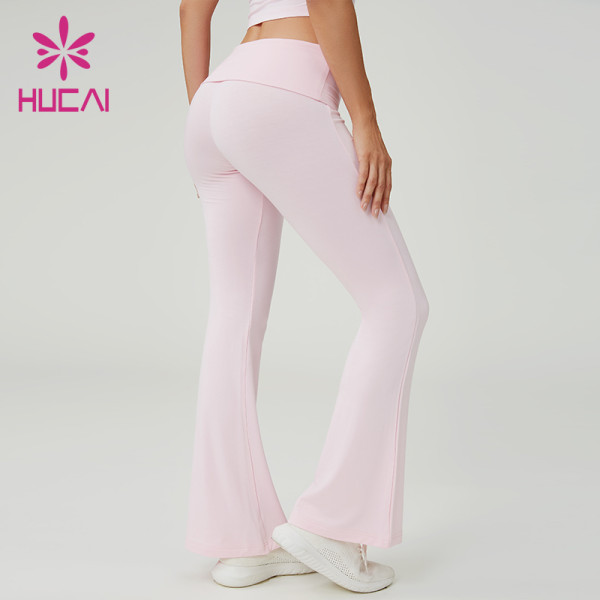
Stable yoga leggings typically rely on balanced compression across the entire garment, rather than relying solely on a tight waistband.
This balanced tension helps the leggings stay aligned with the body during bending, stretching, and rotational movements.
How High-Quality Leggings Achieve Stability
Premium women's activewear brands often focus on stability during the design stage of leggings.
One key approach is pattern engineering, which distributes tension across the hips, waist, and thighs rather than concentrating it in one area.
Another important factor is fabric selection, especially materials with consistent stretch recovery. These fabrics allow leggings to stretch during movement while returning to their original shape afterward.
Finally, waistband construction plays a role in stabilizing the garment. Instead of relying on excessive tightness, well-designed waistbands work with the rest of the garment to maintain even pressure and alignment.
Together, these design elements create leggings that remain stable even during dynamic exercise.
What This Means for Activewear Manufacturers
For an activewear manufacturer, improving garment stability requires looking beyond simple waistband adjustments.
Stability must be considered as a system-level design issue involving pattern balance, fabric recovery, and production consistency.
Pattern engineering determines how tension distributes across the garment during movement. Fabric quality influences how well the garment recovers after repeated stretching. Production precision ensures that each panel maintains the intended stretch direction and alignment.
When these elements work together, women’s activewear leggings can maintain their position during exercise rather than gradually shifting downward.
Rethinking Leggings Fit
The problem of leggings sliding down is often misunderstood as a sizing issue. In reality, it is more accurately a dynamic stability issue.
A well-designed pair of leggings is not simply tight at the waist. Instead, it maintains balanced tension across the garment so that it can adapt to body movement without losing alignment.
For women’s activewear, stability during motion is just as important as comfort or stretch. Understanding this balance is key to designing leggings that perform consistently throughout every movement.
How to contact us
➡️ Contact HUCAI today for your custom outerwear solution and connect with a team committed to premium quality and authenticity.