
Half-Zip Fleece Tops: How to Engineer Zipper, Collar and Hem Stability
A half-zip fleece top sits between a sweatshirt and a jacket, and that is where the problems start. One fastening, one collar that stands or collapses, one hem that must hold shape while the body moves. In UK and Northern European winter ranges, a collar that droops or a placket that ripples after two washes becomes a return a small range cannot absorb. HUCAI Sportswear develops these styles for private label programmes, and the outcome is usually fixed before the first sample: zip and tape, placket stabilisation, collar height and hem recovery. This guide sets them out in review order.
Quick Answer
Four specifications decide zipper, collar and hem stability: the zip and its tape, the placket reinforcement, collar height with interlining, and hem band recovery. A tech pack lets you confirm them in an OEM review; a reference image usually needs ODM development first, because it shows the look, not the stabilisation behind it.
Table of Contents
Who This Article Is For
- Primary reader: founders and product development managers at UK and Western European women's activewear brands adding a winter half-zip.
- Secondary reader: sourcing managers and technical designers who sign off the pre-bulk sample.
- Product stage and problem: tech pack, reference or clear direction, with zip, collar and hem not yet agreed; the sample looks right on the hanger, then the collar loses its stand and the placket waves.
- Who may not need this: buyers sourcing finished stock with no construction change.
What you gain: a specification order for the three highest-risk details and a reusable acceptance table.
Where Half-Zip Fleece Tops Fail: Three Load Points
Complaints cluster at three points, none of them a styling issue. The collar edge carries bulk but little rigidity, so a soft interlining or untrimmed seam allowance lets it fold down. The placket works under tension against a fabric that stretches one way and compresses the other; sewn without stabilising, it waves and pressing will not fix it. The hem band and body recover at different rates, so a poor match lifts above a high-rise waistband or flares.
Recent UK winter drops show half-zip fleece layers across new-arrival ranges from established brands such as Sweaty Betty. That is a public observation of product direction, not a volume claim or a statement about HUCAI Sportswear's clients. The category is crowded on appearance, so the difference sits in whether fastening, collar and hem still behave after washing.
Zipper and Placket Engineering Options
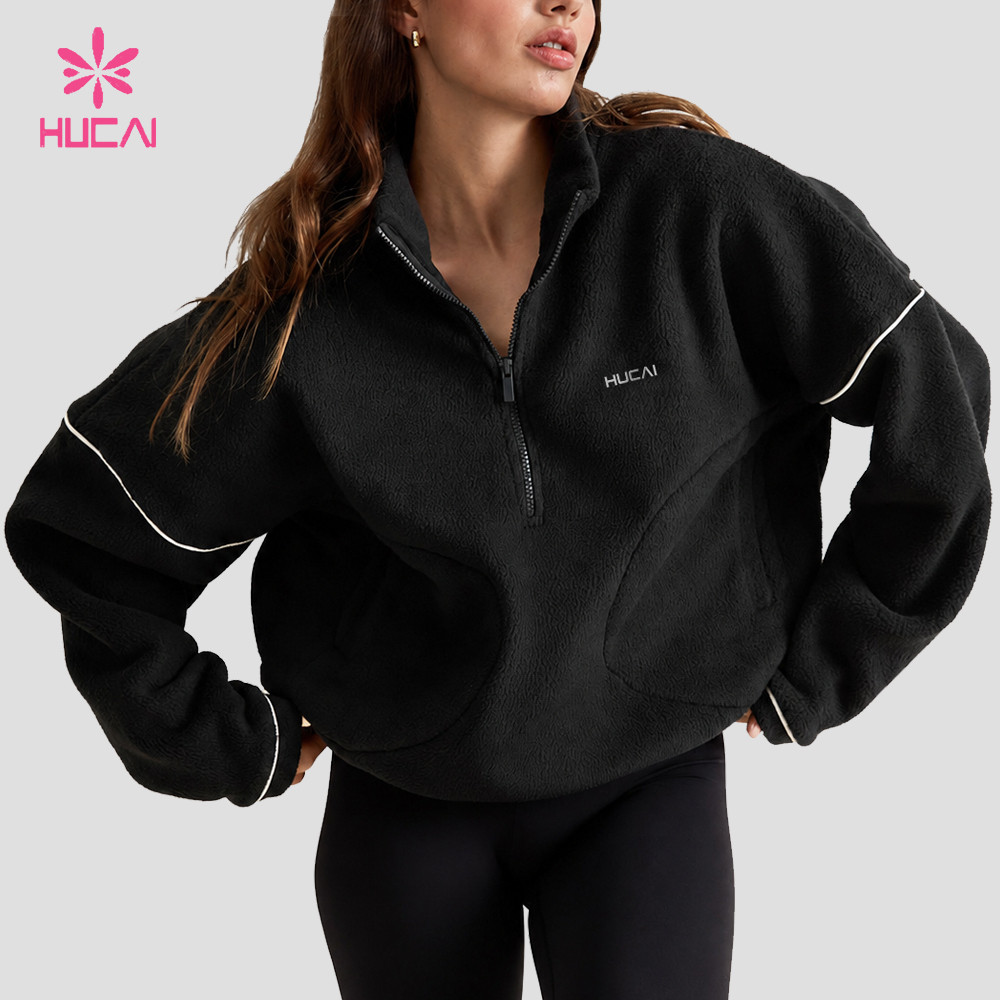
Start with the zip: it sets placket width, collar opening and the cost of every later change. The choices are a standard nylon coil, a reverse-coil with teeth turned inward, or a two-way zip if the collar must vent; metal adds weight at the chin. Four details belong in the tech pack: tape width, top-stop position against the collar edge, garage or chin guard, and how the tape is anchored at the bottom. Buyers most often leave the top stop to the factory, and it decides whether the slider touches the chin.
| Placket route | Suits | Trade-offs | Sample risk |
|---|---|---|---|
| Coil zip, faced placket | Mid-weight fleece, clean front | Lower trim cost, needs interfacing | Placket wave after wash |
| Reverse-coil, narrow storm flap | Colder markets, visible topstitch | Extra seam, bulk at collar join | Bulk where collar meets placket |
| Two-way zip, grosgrain tape | Longer bodies worn open | Higher zip cost, precise handling | Zip misalignment, uneven hem |
In HUCAI Sportswear\'s reviews the placket is structural, not trim: the opening is stabilised before the zip goes in, and the sample is checked flat before wearing.

Collar Height and Stand Structure
Collar height is not one measurement. Record it at centre back and at the front zip end, because those figures decide whether the collar frames the face or falls forward, and the zip length follows the front figure. The stand sandwiches face fabric, interlining and often a lining; fleece bulk means the interlining must add support without adding thickness at the seam.
- Set both figures: centre back and front length, each with a tolerance.
- Name the interlining: tricot rolls softer, firmer non-woven stands sharper.
- Control the join: trim or bind the seam allowance at the placket.
- Check the stop: the slider should sit below the chin line.
HUCAI Sportswear reviews collar height and interlining with the zip, because a collar that stands with one tape can collapse when tape width or stop position changes.

Hem Stability and Band Recovery
Three routes cover most programmes: a rib band, a self-fabric band, or a straight hem with twin-needle or coverstitch. A rib band gives the closest fit and the most controlled recovery, but it pulls the body in and changes how the top layers. A straight hem keeps the volume and relies on the fabric's own recovery. For rib bands, the band-to-opening ratio is what matters: stretch it too far and the seam ripples, leave it loose and the band flares.
- Set the ratio by size, not one figure for the grade.
- Name the band: rib construction, width and elastane content.
- Fix the seam: stitch type, density and differential feed.
A lighter half-zip in a smooth knit shows the same faults differently: the hem sits flatter, while placket wave and collar collapse show more without fleece bulk. Keep separate acceptance notes for each fabric weight.

Sample Acceptance Checks
These are proposed acceptance points, not fixed limits: take final tolerances from your tech pack or the standard your programme references, and agree them before cutting.
| Check | How to test | Proposed acceptance note |
|---|---|---|
| Zip run and top stop | Zip up and down twenty times, close, turn the head | Slider moves freely, stops below the chin |
| Placket flatness | Lay flat, press lightly, measure ripple height | No wave beyond the agreed tolerance |
| Collar stand | Measure back and front, before and after washing | Within tolerance, no forward fold |
| Zip-top contact | Wear closed ten minutes, move the head | No sharp contact at the throat |
| Hem recovery | Measure band and hem before and after washing | Growth within tolerance, no cupping |
Measure after washing as well as before, because a pressed sample hides the behaviour that creates complaints. Photograph the placket and collar edge at the same angle each round.
Bulk Control and What to Put in the RFQ
Bulk risk concentrates in two operations: setting the zip into the placket and attaching the hem band. Both are operator-dependent, so a passing sample does not carry into production by itself. Hold an approved pre-production sample at the line, check the first-off zip setting, check in-line at the collar join and hem attach, and audit measurements across three sizes.
HUCAI Sportswear's quality workflow combines pre-production review, in-process checkpoints and AQL 2.5-based inspection, with sample-to-bulk control on top-stop position, collar height and hem circumference.
- Style count, size range, market and season
- Fleece weight and backing, or the knit for a lighter version
- Zip type, tape width, top-stop position, chin guard
- Collar height at back and front, interlining, lining
- Hem band type, width and ratio, or straight-hem finish
- Logo method, labels, packaging and required test standard
The current public MOQ starts from 100 pcs per style, with colour, size, fabric and trim planning depending on the confirmed project. Samples usually take about 10–15 days; bulk often takes about 25–30 days after approvals.
Decision Check: Is This Half-Zip Ready for Sampling?
Before requesting samples, confirm the following:
- Zip defined: type, tape width and top-stop position written down.
- Placket stabilised: reinforcement named, width fixed.
- Collar specified: back and front heights recorded with the interlining.
- Hem and acceptance agreed: band type, width and ratio set, with wash cycle and tolerances fixed before cutting.
If three or more are confirmed, the direction is ready for a structured sample request. If fewer are resolved, one development conversation costs less than two sample rounds.
Next step: with a tech pack in hand, send the zip, collar and hem figures through the tech pack review route. Starting from a reference garment, the development and sampling overview explains how a reference becomes a measurable brief.
Founder's Technical Insight: Jean Yuan's Development Note
When brands bring us a half-zip reference, the detail that decides the sample round is rarely the one in the photograph; it is what sits behind the placket. A heavy fleece face looks stable on a hanger, but once the tape is sewn without a stabiliser, the opening stretches by the amount the operator pulled it and keeps that memory through washing.
In our sample room the placket is three operations: stabilise the opening, set the zip, topstitch. The collar is fused before the join, because fusing a closed collar distorts the stand. The hem band is measured against the body opening at the machine, since rib relaxes between cutting and attaching.
Four measurements I would verify before bulk: top-stop height against the collar edge, placket wave flat after one wash, collar height at centre back after the same wash, hem circumference against the approved sample.
FAQ
What is the MOQ for a custom half-zip fleece top?
The current public MOQ starts from 100 pcs per style; colour, size, fabric and zip planning depend on the confirmed project.
Can you develop from a reference image instead of a tech pack?
Yes, as ODM development: the image is translated into collar height, placket width, zip type and hem construction.
Which zip suits a women's half-zip fleece top?
It follows the collar design: coil with a faced placket for clean mid-weight styles, reverse-coil with a storm flap for colder markets, two-way for longer bodies worn open.
What collar height should we specify?
Record centre back and front zip-end heights separately, then fix the interlining. A taller back with a short opening reads structured; a shallow collar reads relaxed.
How do we stop the front placket from waving?
Stabilise the opening before the zip is attached, control the feed while sewing, and check the placket flat on a table.
How should collar and hem stability be tested before bulk?
Measure collar height and hem circumference before and after the wash cycle your programme references, then check both stay square to the side seams.
How long do samples and bulk take?
Samples usually take about 10–15 days, depending on style, fabric and revisions; bulk often takes about 25–30 days after approvals.
Final Takeaway
A half-zip fleece top is judged on three details a photograph cannot show: whether the zip stops in the right place, whether the collar keeps its stand, whether the hem recovers. Settle those in the specification and the sample round becomes confirmation rather than negotiation. HUCAI Sportswear supports women\'s activewear brands with OEM and ODM development and sample-to-bulk control, so the next action is to put the zip, collar and hem figures into one brief.
About HUCAI Sportswear
- Founded in 1998, manufacturing women's activewear in Dongguan, China
- OEM and ODM development for bras, leggings, shorts, tops and sets
- Structured sample development with sample-to-bulk consistency control
- AQL 2.5-based inspection within the quality workflow
Current certification information can be reviewed during supplier evaluation based on the project and documentation requirements.