
Stretch-Shell Light Jackets for Women's Activewear: Mobility, Breathability and Fabric Compatibility
A light jacket is often the piece that decides whether a women's activewear capsule works beyond the studio. When a brand adds a stretch-shell layer to a training or outdoor range, the development brief usually starts with how it looks. The harder questions are mechanical. How much stretch does the shell actually need? How does the fabric behave over a rib cuff, a zip tape, or a lining? Does the layer still allow reach and rotation once it is worn over a bra and a long-sleeve top? Those decisions are what separate a light jacket that holds a place in the range from one that generates sample revisions and inconsistency at bulk. HUCAI Sportswear develops women's activewear for private label and OEM programmes, and this guide treats a stretch-shell light jacket as a product development problem rather than a styling choice.
Quick Answer
A light activewear shell should be developed around mobility and layering compatibility first. Stretch direction, fabric weight, air movement, trim behaviour, and the garments it will be worn over all determine whether the jacket functions as activewear or as generic outerwear. Weather resistance is a project-specific material requirement to confirm, not a default claim. Buyers working from a defined shell brief can usually move into OEM review, while buyers starting from a reference image generally need fabric and construction development before sampling.
Table of Contents
- Who This Article Is For
- What a Light Activewear Shell Is and Is Not
- Stretch Direction and Where Mobility Panels Belong
- Breathability, Weight and the Layering Question
- Fit, Grading and the Layering Variable
- Zips, Hems, Cuffs and Trim Compatibility
- What to Confirm Before Approving a Shell Sample
- Decision Check
- Development Next Step
- Manufacturer Insight
- FAQ
- Final Takeaway
Who This Article Is For
- Primary reader: Growing brands adding a first light layer to a women's activewear range.
- Secondary reader: Private label buyers extending an existing bras, leggings and tops programme into outer layers.
- Product stage: Early product direction, reference-image stage, or a first shell development round.
- Inputs you may already have: Reference images, a capsule plan, an existing fabric family, and a target retail position.
- Problem being solved: Defining stretch, weight, air movement, and layering requirements before a sample is requested.
- Who may not need this article: Brands sourcing fully weatherproof technical mountaineering shells, where the requirement set and material direction are different.
What you gain from this article: a clearer shell requirement brief covering mobility, air movement, layering ease, trim compatibility, and the specific points to confirm before a sample request is placed.
What a Light Activewear Shell Is and Is Not
A light activewear shell sits between a training top and a general outdoor jacket. Its purpose is to add coverage during warm-up, cool-down, commute, and transition weather without turning the outfit into a winter layering system. That role definition matters because it sets the requirement list. A shell designed for a training-to-commute routine is judged on movement, weight, and how it sits over a bra and a long-sleeve top. It is not judged on the same specification set as a heavy weather shell.
In manufacturing terms, the role defines four decisions: the stretch the shell needs, the weight it can carry, the amount of air movement the fabric allows, and how the piece layers over the rest of the capsule. When those four are left implicit, the brief usually defaults to appearance, and the sample round becomes the place where the real requirements are discovered. That is an expensive way to find them.
For brands that already work with a defined construction file, the shell can move through OEM development using confirmed measurements, materials, and branding. For brands starting from a reference image or a mood direction, the same product is usually better handled as an ODM development project, where product direction, fabric, and construction are clarified together before sampling.

Stretch Direction and Where Mobility Panels Belong
Stretch is not a single number. What matters for a light shell is the direction of stretch relative to the movement the garment has to allow. Across the back and shoulder, the body rotates and reaches. Through the sleeve, it extends and bends. At the hem, it needs to stay put while the hip flexes. A shell whose main panel stretches comfortably in one direction but not the other will feel restrictive even if the fabric tested well on its own.
This is where mobility panels earn their place. A panel placed across the upper back, along the underarm, or through the elbow region can carry the movement requirement while the main shell body stays stable. The design question is not whether to add panels, but where the movement requirement actually sits for the intended use.
The practical consequence is that stretch direction should be written into the brief before sampling. If it is not, the first sample will show the requirement through symptoms: a locked shoulder line, a hem that lifts when the arms raise, or a slight pull across the chest when the jacket is zipped over a training top.
Breathability, Weight and the Layering Question
Weight and air movement work against each other, and the balance depends on what the jacket will be worn over. A shell intended as a light outer layer over a bra and a top can carry less weight than one expected to sit over a mid layer. Heavier fabric usually reads as more protective, but it also changes drape, packability, and how the piece feels during movement.
When the requirement is not defined, the usual outcome is a fabric that performs in isolation but not inside the system. A shell that is pleasant on the hanger can feel bulky over a fitted long-sleeve layer, or contribute too much warmth during active use. The better approach is to specify the layer stack first: what goes underneath, how many layers, and in what temperature range.
Air movement should be treated as a development requirement rather than a claim. Options may include a more open knit structure, ventilation zones, or a lighter material direction, but the right choice depends on the intended use and must be confirmed against the actual fabric and construction. Fabric direction and review points for this decision sit in the wider activewear fabric selection process, where stretch, recovery, opacity, and surface behaviour are reviewed together rather than in isolation.
Fit, Grading and the Layering Variable
A light shell has one fit variable that a training top does not: it must accommodate another garment underneath. That changes how ease is distributed. Comfort across the chest is measured over a bra and a top, not over the body. Sleeve circumference has to clear a long-sleeve layer without compressing it. The hem needs enough room to sit over a waistband without riding up during movement.
Grading adds a second layer of difficulty. A shell that fits correctly at a mid size can collapse or balloon at the ends of the size range if the grading rules were carried over from a fitted top rather than re-derived for a layered garment. This is a common reason a jacket that looks right in one size fails review across a full size set.
Women's outer layers also carry proportion decisions that affect the development brief: hem length relative to the leggings rise, shoulder line relative to the armhole, and how the front closure reads when the jacket is worn open or closed. These are pattern choices as much as design choices. Women's outerwear categories show how those decisions separate a light layer built for movement from a general jacket, and the same logic applies when a brand extends an existing activewear range into its womens outerwear layer.
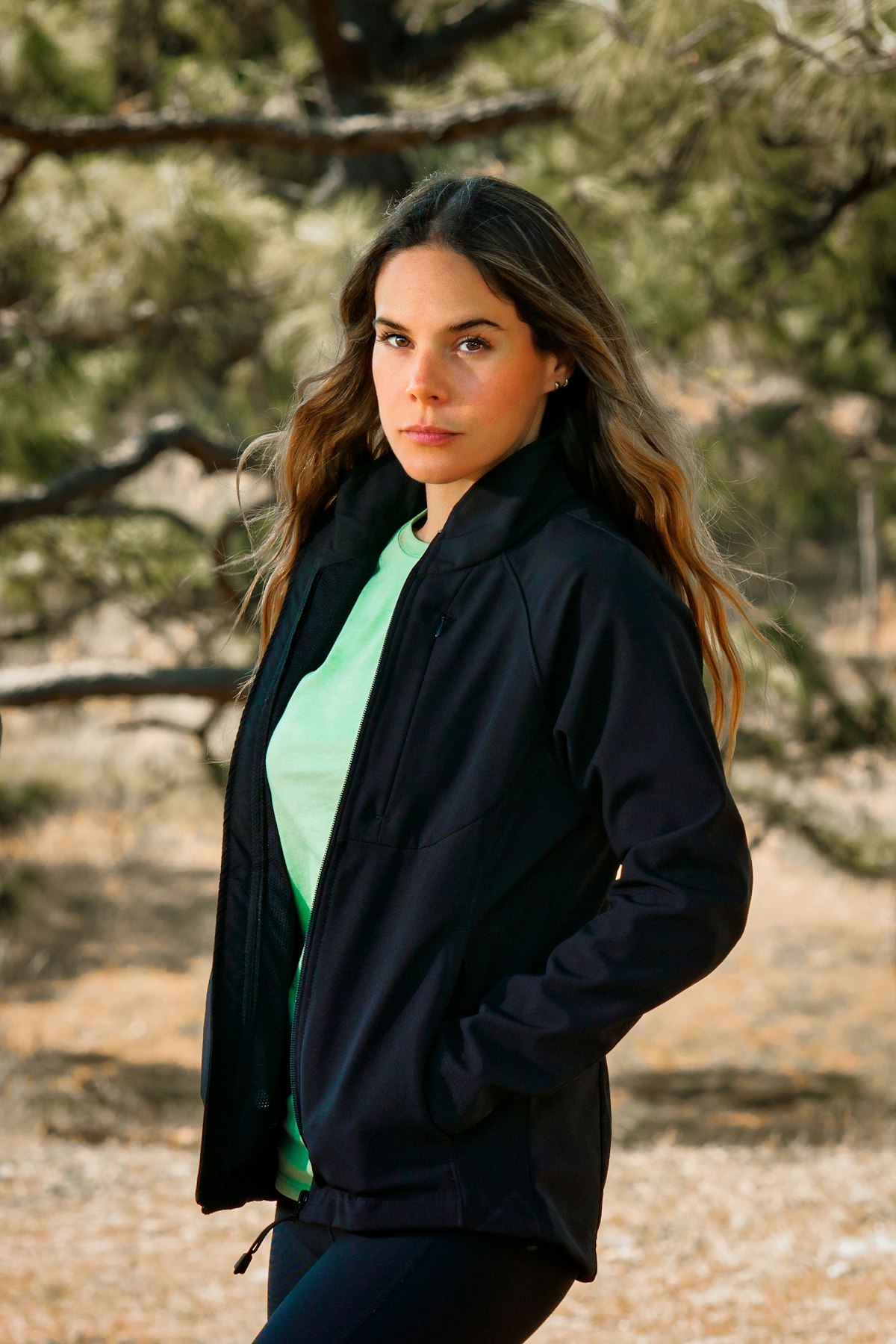
Zips, Hems, Cuffs and Trim Compatibility
Most light-shell sample issues do not come from the main fabric. They come from the point where the main fabric meets a trim. A zip is comparatively stiff, and a stretch shell is comparatively mobile. If the two are not matched, the result is a zip line that waves, a front panel that puckers, or a hem that distorts once the jacket is closed.
The same logic applies to cuffs, hood edges, drawcords, pocket openings, and any elastic element. Each one introduces a local area where the stretch behaviour of the shell changes. That is why trim should be reviewed as part of the fabric decision rather than as a finishing detail selected afterwards.
The table below sets out the main compatibility points. It is a review structure, not a fixed specification: the correct choice depends on the confirmed shell fabric and the intended use.
| Component | What to confirm before sampling |
|---|---|
| Front zip | Zip tape stiffness relative to shell stretch, and whether the zip needs a backing or a guard |
| Sleeve cuff | Whether the cuff is elastic, rib, or self-fabric, and how it behaves when the arm is extended |
| Hem | Drawcord, elastic, or clean finish, and how the hem holds position over a waistband |
| Hood | Hood depth and edge finish relative to the neckline and the layer underneath |
| Pockets | Opening placement and reinforcement where they interrupt the shell panel |
| Lining | Whether a lining is needed, and whether it moves with the shell or against it |
Where the jacket sits inside a broader hoodie and jacket programme, the trim set is usually shared across styles. Reviewing the panel and trim interaction once, early, reduces rework across the rest of the range. Buyers building a custom hoodie and jacket programme can confirm the shared trim standard at the same time as the shell fabric.
What to Confirm Before Approving a Shell Sample
A light-shell sample should be reviewed in movement, not only on a hanger. Static review confirms measurements and finish. Movement review confirms whether the garment actually works for the intended activity. The difference matters because a shell can pass measurement review and still fail on the shoulder line once the arms raise.
A practical sample review covers four areas. First, measurements against the confirmed specification, taken on the garment at rest. Second, movement: raise both arms, reach forward, rotate the torso, and sit down. Third, layering: put the jacket on over the exact base and mid layers it will be sold with. Fourth, trim behaviour along the zip, hem, cuff, and hood after the jacket has been worn and closed repeatedly.
Where a wash or wear review is relevant to the project, it should be confirmed before bulk rather than assumed. Sample approval points and revision planning are set out in the standard sample development process, and the controls that carry an approved sample through to bulk are described under sportswear quality control.
Decision Check: Is This Light Shell Direction Ready for Sampling?
Before requesting a sample, confirm the following:
- Intended use: The activity, climate, and position in the range are written down, not implied.
- Layer stack: The base and mid layers the jacket will be worn over are identified.
- Stretch and recovery direction: The direction of stretch relative to movement is defined, and mobility panel placement is decided.
- Weight and air movement target: A material direction is agreed, or the review criteria for choosing one are agreed.
- Trim standard: Zip, cuff, hem, hood, and pocket construction are nominated, and their compatibility with the shell is reviewed.
- Size set and grading: The size range is confirmed, and grading is derived for a layered garment rather than carried over from a fitted style.
If four or more of these are confirmed, the direction is ready for a structured sample request. If fewer are resolved, resolving them first generally reduces sample revision rounds and avoids re-cutting a pattern once the shell fabric is already approved.
Development Next Step
If the shell brief is defined, send the fabric direction, target layering, zip and hem construction, and size range for OEM development review. If the project is still at the reference-image stage, share the images, the category the jacket will sit in, and the intended use, and the ODM development path can clarify fabric, construction, and sample priorities before bulk planning.
Manufacturer Insight
A common failure pattern in light-shell development is that the fabric is tested and approved on its own, and then the jacket fails at the trim. A shell that meets its stretch and recovery target can still pucker along a zip, wave at the hem, or distort where an elastic cuff pulls against the main panel. The fabric is only half the decision.
In many transitional light-jacket projects, the sample issue is not the shell material itself but the way it interacts with rib, zip tape, lining, and elastic. This is why fabric and trim are better reviewed as one system, and why the panel interaction is worth confirming before the first sample is cut rather than after.
FAQ
What makes a jacket suitable for activewear rather than general outerwear?
Movement requirement is the main difference. An activewear shell is developed around the range of motion of the intended activity, the layers it will be worn over, and the weight it can carry without restricting movement. General outerwear is usually developed around weather protection and coverage first, with mobility treated as a secondary consideration.
How much stretch should a light shell have?
There is no single target, because the requirement depends on the intended use and on where the movement happens. What matters is the direction of stretch relative to movement and whether mobility panels carry the reaching and rotation zones. The stretch and recovery requirement should be confirmed as part of the fabric review rather than set as a fixed number in advance.
Is water resistance always necessary for a women's activewear jacket?
No. Weather resistance is a project-specific material requirement, not a default expectation for every light shell. Some light jackets are developed around warmth and coverage for transition weather, where the priority is weight, movement, and layering compatibility. Where weather protection is required, the exact level and the supporting documentation should be confirmed for that project.
What causes zipper waviness on a stretch jacket?
Zipper waviness usually comes from a mismatch between the stiffness of the zip tape and the stretch behaviour of the shell fabric. The zip resists movement while the shell moves with the body, so the front panel can buckle along the zip line. It is normally addressed through zip selection, panel construction, or a supporting layer rather than by changing the shell fabric alone.
How should layering ease be defined for a light jacket?
Layering ease should be defined against the actual garments the jacket will be worn over, not against body measurements alone. The practical approach is to confirm the base and mid layers first, then set chest, sleeve, and hem ease so the jacket sits over that stack without compressing it or restricting the wearer's movement.
Which details should be reviewed at the sample stage?
Four areas are worth covering: measurements taken on the garment at rest, movement review with the arms raised, reaching forward, rotating the torso, and sitting; layering review over the exact base and mid layers; and trim behaviour along the zip, hem, cuff, and hood after repeated closing and wearing.
What is the MOQ for a private label light jacket?
The current public MOQ starts from 200 pcs per style. Final colour, size, fabric, trim, and customization planning depends on the confirmed project. Fabric choice, the number of colours, the size range, the trim set, and the level of customization can each affect how the order is planned.
How long does a light jacket sample usually take?
Sample development usually takes about 10-15 days, depending on style, fabric, trim, logo, revision requirements, and confirmed details. Bulk production often takes about 25-30 days after pre-production details and approvals are confirmed, depending on project scope, materials, processes, quantity, and scheduling.
Final Takeaway
A stretch-shell light jacket works when it is developed around mobility and layering first. The role of the piece sets the stretch direction, the weight and air movement target, the ease required over the base and mid layers, and the trim set that has to survive that movement. Confirming those points before the first sample is what keeps a light layer in the range and out of the revision cycle. The practical next step is to write down the layer stack, the intended use, and the trim standard, then submit that brief with either a tech pack or a reference image set.
About HUCAI Sportswear
- Founded in 1998, HUCAI Sportswear is a women's activewear and sportswear manufacturer in Dongguan, China.
- OEM and ODM development support, including private label development, sample development, and bulk production.
- Development workflow combining fabric, trim, pattern, CAD, and sample support.
- MES and ERP-supported tracking together with a hanging production system support scheduling and order follow-up.
- Quality workflow combining pre-production review, AQL 2.5-based checkpoints, in-process inspection, final inspection, and sample-to-bulk consistency control.
Current certification information can be reviewed during supplier evaluation based on the project and documentation requirements.