
Why Fabric Family Strategy Matters: Building a Cohesive Activewear Line Without Product Cannibalization
Many growing activewear brands fall into a common sourcing trap: they add products one at a time, each with a different fabric direction. The result is a fragmented product line where every style competes for attention instead of building a coherent collection. When a fabric selection decision is made in isolation, the brand ends up with high MOQ fragmentation, inconsistent quality across SKUs, and rising sample costs that eat into margin before the first bulk order ships. For private label and ODM buyers working with women's activewear manufacturers, the difference between a reactive product list and a deliberate fabric family strategy often determines whether the brand scales cleanly or stalls at the sampling stage. HUCAI Sportswear has seen this pattern across hundreds of development projects: the most operationally efficient growing brands are not the ones with the most SKUs, but the ones that build product architecture around a small number of repeatable fabric families.
Quick Answer
A fabric family strategy means selecting a small set of fabric bases (often two to four) that can support multiple product types across a collection—for example, one high-stretch nylon-spandex for leggings and sports bras, one brushed poly-spandex for jackets and joggers, and one lightweight mesh for layering pieces. This approach reduces MOQ fragmentation by allowing buyers to place larger orders per fabric rather than spreading minimums across many incompatible fabrics, supports consistent quality and hand feel across a capsule, and simplifies sample development by reducing the number of construction variables the development team must review. For brands planning private label activewear development, fabric family architecture should be defined before finalizing the SKU list, not after.
Table of Contents
- Who This Article Is For
- What Is a Fabric Family in Activewear Production
- How Fabric Fragmentation Creates Product Cannibalization
- How to Select Core Fabric Families for a Cohesive Line
- MOQ and Cost Implications of Fabric Family Planning
- Aligning Fabric Families With OEM and ODM Development Paths
- Fabric Family Planning Before Sample Development
- Decision Check
- Manufacturer Insight
- FAQ
- Final Takeaway
Who This Article Is For
- Primary reader: Growing activewear brands with five to thirty active SKUs, planning their next capsule expansion
- Secondary reader: Private label buyers and sourcing managers evaluating fabric direction before placing a development order
- Product stage: Brands moving from reactive SKU-by-SKU sourcing to structured collection development
- Problem being solved: Product cannibalization, MOQ fragmentation, inconsistent quality across SKUs, and rising sample costs caused by using too many unrelated fabrics in one collection
- Who may not need this article: Startup brands developing only one or two initial styles, or established brands with a mature and fully documented fabric architecture already in place
What you gain from this article: A practical decision framework for selecting two to four core fabric families before developing a new activewear capsule. You will understand how fabric choices affect MOQ, sample timing, and product cannibalization risk, and how to align your fabric plan with either OEM or ODM development paths.
What Is a Fabric Family in Activewear Production
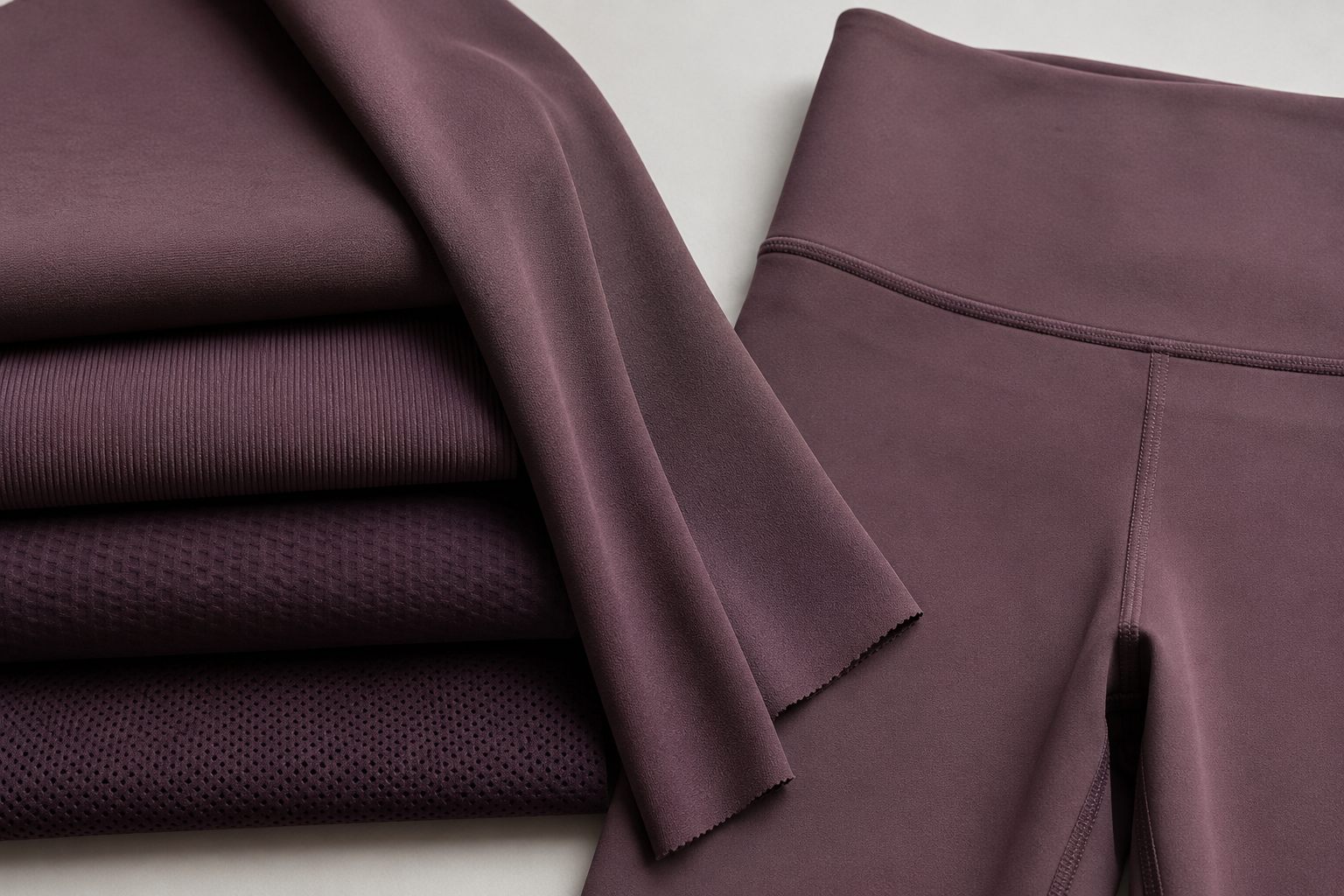
A fabric family is a group of products that share the same base material foundation—the same fiber composition, similar weight, and consistent stretch and recovery behavior. In women's activewear development, common fabric families include a high-stretch nylon-spandex base for compression leggings and sports bras, a brushed poly-spandex base for soft-touch mid layers and joggers, a lightweight moisture-management base for training tops and liners, and a structured rib or textured knit base for sculpted studio pieces.
The concept goes beyond simply choosing one fabric per product type. It means the buyer and the leggings manufacturer agree that the same nylon-spandex base used for the main leggings body can also be used for the sports bra main panels, the bike short body, and the unitard construction. This shared fabric base creates natural product cohesion without limiting design variety—color blocking, contrast panels, trims, and construction details can still differentiate individual SKUs.
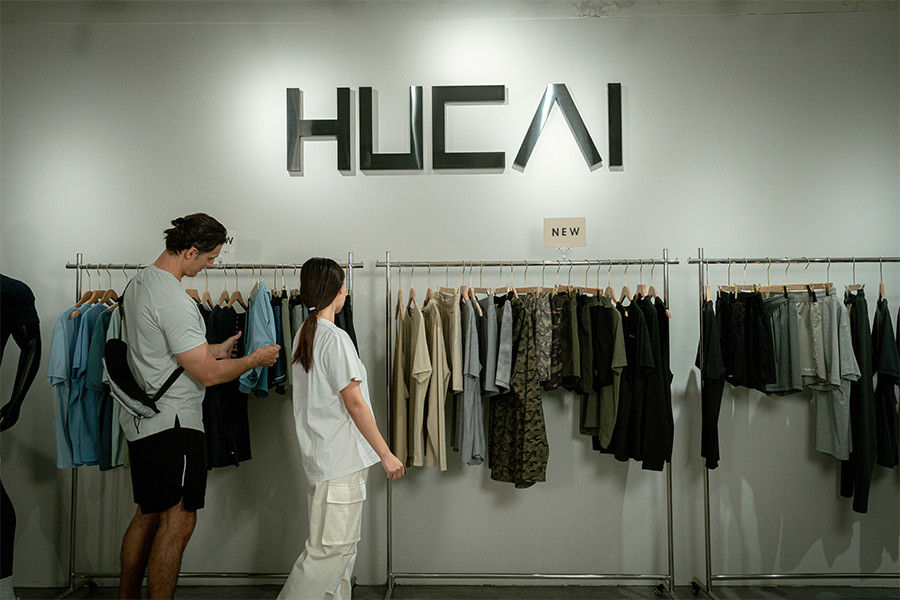
When HUCAI Sportswear reviews development projects from growing brands, one of the first recommendations is to map all planned products onto the smallest practical number of fabric bases. This exercise often reveals that twelve SKUs can be built from three fabric families rather than eight separate fabric directions, which immediately reduces sample complexity and MOQ pressure.
How Fabric Fragmentation Creates Product Cannibalization
Product cannibalization in a private label activewear line does not only come from similar styles competing for the same customer. It often starts at the fabric level. When a brand develops five leggings using five different fabric bases, the development team must run five separate sample rounds, five separate color and shade approval processes, and five separate shrinkage and recovery reviews. This multiplication of development effort does not improve product quality—it dilutes resources and makes it harder for any single product to reach its development target.
From a sourcing perspective, fabric fragmentation also weakens the buyer's position on MOQ. Each fabric carries its own minimum, and when MOQ from 100 pcs per style is spread across many different fabric directions, the total order volume per fabric drops below efficient production thresholds. This can increase unit cost, extend lead time, and create additional quality risk because each fabric batch is processed in a smaller, less stable production run.
From a brand-building perspective, a fragmented fabric line creates an inconsistent customer experience. Two leggings that look similar online but feel different in hand can confuse buyers and increase return rates. A cohesive fabric family strategy keeps the tactile and performance experience consistent across the collection while allowing design variety through color, construction detail, and trim choice.
How to Select Core Fabric Families for a Cohesive Line
Selecting core fabric families should start with the brand's intended product architecture, not a fabric swatch book. Begin by listing every planned product and its primary performance requirement: compression and opacity for leggings, support and breathability for sports bras, drape and softness for studio tops, warmth and structure for jackets. Group products by shared performance demands, then look for fabric bases that can serve multiple groups.
A well-planned activewear capsule often works with two to four core fabric families. A common architecture for a yoga and training capsule might use a high-stretch nylon-spandex base (for leggings, bike shorts, sports bra panels, and unitards), a brushed poly-spandex or cotton-spandex base (for joggers, hoodies, and relaxed-fit cropped tops), and a lightweight mesh or rib base (for layering tanks, bra overlays, and cover-ups). With these three families, a brand can build eight to fifteen differentiated SKUs without adding a fourth fabric direction.
The key discipline is resisting the temptation to add a new fabric for a single product. Before introducing an additional fabric base, ask whether the intended product function can be achieved by adjusting construction, paneling, lining, or trim within an existing fabric family. In many cases, changing the rise, waistband structure, or seam placement achieves the product differentiation the brand needs without adding a new fabric to the development plan.

MOQ and Cost Implications of Fabric Family Planning
Fabric family strategy directly affects MOQ feasibility and unit cost. The current public MOQ starts from 100 pcs per style, but final color, size, fabric, trim, and customization planning depends on the confirmed project. When a brand concentrates its total order volume into two or three fabric bases instead of spreading it across six or seven, the per-fabric order quantity increases significantly. This larger volume per fabric often supports more stable pricing, better production scheduling, and more consistent quality because the production team runs larger, more repeatable batches.
Consider a growing brand ordering 2,000 total pieces across ten styles. If those ten styles use six different fabric bases, the average order per fabric drops to roughly 330 pieces, and some fabrics may fall to 100 pieces or fewer. If the same ten styles are built on three fabric families, the brand can place 600 to 800 pieces per fabric, which is a more production-friendly volume at the standard MOQ level. The difference is significant for private label buyers who need every dollar of development spend to contribute to sellable inventory rather than absorbed into MOQ minimums for fabrics that will not be reordered.
Color planning also becomes more efficient within a fabric family framework. When the same fabric base is used across leggings, sports bras, and shorts, the brand can order one shade lot per color and apply it to multiple products. This reduces shade matching risk between product types and supports the coordinated look that is central to a matching set or capsule collection.
Aligning Fabric Families With OEM and ODM Development Paths
Fabric family strategy looks different depending on whether the brand follows an OEM or ODM development path. For OEM projects, where the buyer provides a tech pack, confirmed specifications, and fabric direction, the fabric family should be defined in the tech pack before requesting samples. The buyer specifies which fabrics apply to which products, and the manufacturer reviews the plan for production feasibility, MOQ alignment, and consistency risk. HUCAI Sportswear reviews fabric-family plans during OEM project evaluation to identify potential fragmentation before samples are cut.
For ODM projects, where the buyer brings reference images, a capsule concept, or an early product direction, the fabric family is often built collaboratively during product development. The manufacturer proposes fabric bases that can support the buyer's product architecture based on available fabric resources and production capabilities. The buyer reviews hand feel, stretch, recovery, and opacity against their brand standard, and the two sides converge on a core fabric family set before sampling begins.
In both paths, the most cost-effective moment to define fabric families is before sample development starts. Once samples are produced across multiple fabrics, changing direction becomes expensive, and the brand may be locked into a fragmented architecture that affects every subsequent order. For ODM projects, buyers should plan to review fabric proposals at the same time they review style sketches, not as a separate step that follows later.
Fabric Family Planning Before Sample Development
The most common mistake growing brands make is finalizing the SKU list and design direction before defining the fabric architecture. When fabric decisions are made after the design is locked, the development team is often forced to accept fabric compromises—using a different base for the leggings than for the matching sports bra because the planned fabric does not have the right recovery for the bra underband. This creates the fragmentation problem the brand was trying to avoid.
A structured fabric family planning sequence should look like this: define the product categories in the capsule (sports bras, leggings, shorts, tops, jackets), identify the shared performance requirements across those categories (stretch, recovery, opacity, hand feel, weight), select the minimum number of fabric bases that can satisfy those requirements, and only then finalize the specific product designs within each fabric family. This sequence ensures that design decisions are made within the constraints of a production-friendly fabric architecture rather than forcing production to accommodate an unconstrained design vision.
For brands working with quality control processes, fabric family planning also simplifies sample-to-bulk consistency management. When the development team reviews shrinkage, colorfastness, and recovery for three fabric bases instead of eight, each fabric receives more focused attention during pre-production review and in-process inspection. This supports the sample-to-bulk consistency control that is part of a structured quality workflow.
Decision Check: Is Your Fabric Architecture Ready for Development?
Before requesting samples, confirm the following:
- All planned products mapped to fabric families: Every SKU in the capsule is assigned to one of two to four core fabric bases, with no fabric used for only a single product unless there is a clear performance justification
- Per-fabric MOQ confirmed as viable: The total order quantity per fabric family meets or exceeds the standard MOQ threshold, and no fabric direction has a marginal order volume that could delay production
- Fabric performance requirements documented: Stretch, recovery, opacity, hand feel, and weight targets are specified for each fabric family, and the development team has reviewed fabric proposals against those targets
- Color and shade planning aligned with fabric families: Shared colors across products within the same fabric family are planned from a single shade lot to support coordinated capsule presentation
- OEM or ODM path confirms fabric feasibility: The development path (tech-pack-led or reference-image-led) has been reviewed, and the manufacturer has confirmed that the proposed fabric families can be supported within the project timeline and budget
If three or more criteria are confirmed, the fabric architecture is ready for a structured sample request. If fewer than three are resolved, additional fabric planning before sampling will reduce revision cycles and control development cost.
Manufacturer Insight
One pattern that consistently delays activewear development is the brand that sends twelve reference images, each showing a visibly different fabric surface, without clarifying which fabrics should be shared across products. The development team sees twelve images and assumes twelve fabric directions, which creates twelve separate sample streams, twelve separate revision cycles, and a compounded quality review burden. When the manufacturer asks the brand whether any fabrics can be consolidated, the answer is often yes—but the consolidation happens after samples are already in progress, which means some sample cost has already been spent on redundant directions. The most efficient brands in HUCAI Sportswear's development pipeline are those that send images with fabric-group annotations: "Images A, B, and C all use Fabric 1. Images D, E, F, and G use Fabric 2." This small upfront effort, before the first sample is cut, reduces sample complexity, speeds up revision rounds, and produces a more commercially coherent collection.
FAQ
How many fabric families should a growing activewear brand use?
Most growing brands with five to thirty SKUs can build a cohesive and commercially viable collection with two to four core fabric families. Each family serves a distinct performance and category role: one high-stretch base for compression and support products, one soft-touch base for lifestyle and mid-layer pieces, and optionally one lightweight or textured base for layering or studio-specific products. Adding more than four fabric families without a clear performance requirement usually increases MOQ fragmentation and sample cost without delivering proportional design benefit.
Does using fewer fabrics limit design creativity?
No. The same fabric base can support a wide range of products through construction, color blocking, panel placement, trim choices, and branding details. Design differentiation comes from how the product is built, not only from which fabric is used. A single nylon-spandex base can produce a full-length compression legging, a bike short, a racerback sports bra, a longline bra, and a unitard—five distinct products, one fabric family, one MOQ calculation, and one quality control standard.
What is the MOQ for private label activewear with a fabric family approach?
The current public MOQ starts from 100 pcs per style, while final color, size, fabric, trim, and customization planning depends on the confirmed project. When products within a fabric family share the same base material, the total order volume per fabric is higher, which supports more stable production pricing and scheduling. Buyers should discuss per-fabric volume targets with the manufacturer during the fabric planning stage.
Can fabric families be adjusted after sampling begins?
Adjustments after sampling starts are possible but add cost and time. Changing a fabric base after the first sample round means the new fabric must go through its own shrinkage test, recovery review, and color matching process. If the change affects multiple products in the capsule, the revision cycle multiplies. The most cost-effective approach is to define fabric families completely before the first sample is cut and to use the sample stage only for fit, construction, and branding confirmation within the agreed fabric architecture.
How does fabric family planning affect sample development time?
Sample development usually takes about 10-15 days, depending on style, fabric, trim, logo, revision requirements, and confirmed details. When samples are concentrated in fewer fabric families, the development team can run batches more efficiently because fabric preparation, cutting, and sewing setups are repeated across similar constructions. This does not shorten the per-sample timing but does reduce the total calendar time needed to complete a full capsule sample set compared with managing many unrelated fabric directions simultaneously.
Should OEM and ODM projects approach fabric families differently?
Yes. In OEM projects, fabric families should be defined by the buyer in the tech pack, and the manufacturer reviews the plan for feasibility. In ODM projects, fabric families are often developed collaboratively: the buyer communicates the product architecture and performance requirements, and the manufacturer proposes fabric bases from available resources. In both cases, fabric family decisions should be made before sampling, not during or after.
What documentation should a buyer prepare for fabric family review?
At minimum, a buyer should prepare a product-to-fabric mapping document that lists each planned SKU, its assigned fabric family, and the key performance requirements for that family (stretch direction, recovery expectation, opacity target, hand feel preference, and weight range). Reference images should include annotations indicating which fabric family applies to each image. If the buyer has swatch references or competitor samples, these help the manufacturer understand the tactile and visual direction.
Can recycled or certified fabrics be integrated into a fabric family strategy?
Recycled or certified material options can be reviewed based on project requirements and available documentation. The same fabric family logic applies: if the brand wants to use a recycled nylon-spandex base, plan for that fabric to serve multiple product types in the collection rather than using it for a single SKU. Certification claims require current verification during supplier evaluation.
Final Takeaway
Fabric family strategy is not about limiting product variety. It is about enabling a growing brand to scale production efficiently by building products on a consistent, repeatable material foundation. When a brand plans fabrics before finalizing designs, it reduces MOQ fragmentation, controls sample cost, supports consistent quality across SKUs, and creates a collection that feels intentional rather than assembled. For private label buyers developing their next activewear capsule, the question is not "how many fabrics can we use?" but "what is the smallest number of fabric families that can deliver our product vision?" Answering that question before the first sample request is the difference between a streamlined development cycle and a fragmented one.
About HUCAI Sportswear
- Founded in 1998, specializing in women's activewear and sportswear manufacturing
- OEM and ODM development support for sports bras, leggings, shorts, tops, and matching sets
- Fabric review and development coordination across nylon-spandex, poly-spandex, brushed, and textured knit families
- Structured sample development and sample-to-bulk consistency control
- AQL 2.5-based inspection as part of the quality workflow
Current certification information can be reviewed during supplier evaluation based on the project and documentation requirements.