
Mesh-Insert Sports Tops: Where to Position Ventilation Without Gaping
Mesh is the least expensive way to add ventilation to a sports top, and one of the fastest ways to create a gaping neckline. The insert is lighter and usually more extensible than the shell, so under the same load it takes more length. Stitch it into a curved armhole or neckline and the surplus has to go somewhere: a wave along the join, or an edge that stands away in a forward bend.
HUCAI Sportswear treats a mesh insert as a panel-engineering decision, not a fabric choice. For private label buyers that decides whether the first sample tests placement or repairs a join. This guide covers the positions that hold, the pairing that keeps a panel flat, and the RFQ inputs that carry the decision into bulk.
Quick Answer
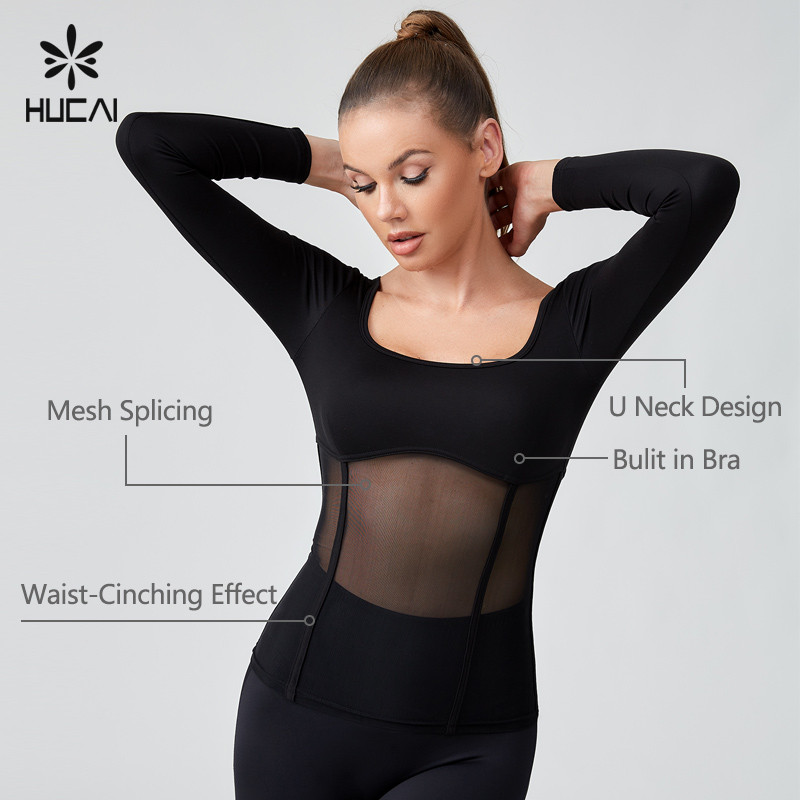
Place mesh where the shell can carry the load and the join runs along a straight or gently curved line: mid-back, side bodice and midriff are the most stable. Front neckline and armhole inserts gap most, where several load directions meet. Match mesh to shell by measured extension, define a seam intake, and approve the insert in movement and after washing.
Table of Contents
Who This Article Is For
- Primary reader: product developers and technical designers specifying a mesh-insert sports top.
- Secondary reader: sourcing managers comparing a mesh insert against perforation or an open back.
- Stage: references exist; position, intake and edge finish are not fixed.
- Problem: the sample lifts at the neckline, waves along the insert, or distorts after one wash.
What you gain: a placement map, a way to pair mesh with shell by measurement, a proposed acceptance table, and the RFQ fields that keep the decision from being reopened at cutting.
1. Why the Join Fails
Public AW26 range pages from Nordic brands such as Casall show mesh used as a design element across tops and bras. That is an observation of product direction, not evidence of demand.
In the sample room the mesh rarely fails; the join does. A second fabric brings its own extension, recovery and edge behaviour to a garment drafted around one shell. Extension mismatch makes the seam wave, because the mesh stretches further and the join carries the difference. Grain direction changes the fit, and an open knit holds less shape at the cut edge, so the finish must stabilise the opening without stiffening it.
None of this is a fabric fault; it is what happens when a second material sits where the shell is under tension. The earlier article on vented performance tops covers airflow; this one is about position and the join.
2. Five Positions, Ranked by Risk
Gaping risk is not evenly distributed. These positions cover most inserts, ordered by join load.
| Position | Ventilation | Gaping risk | Pattern impact |
|---|---|---|---|
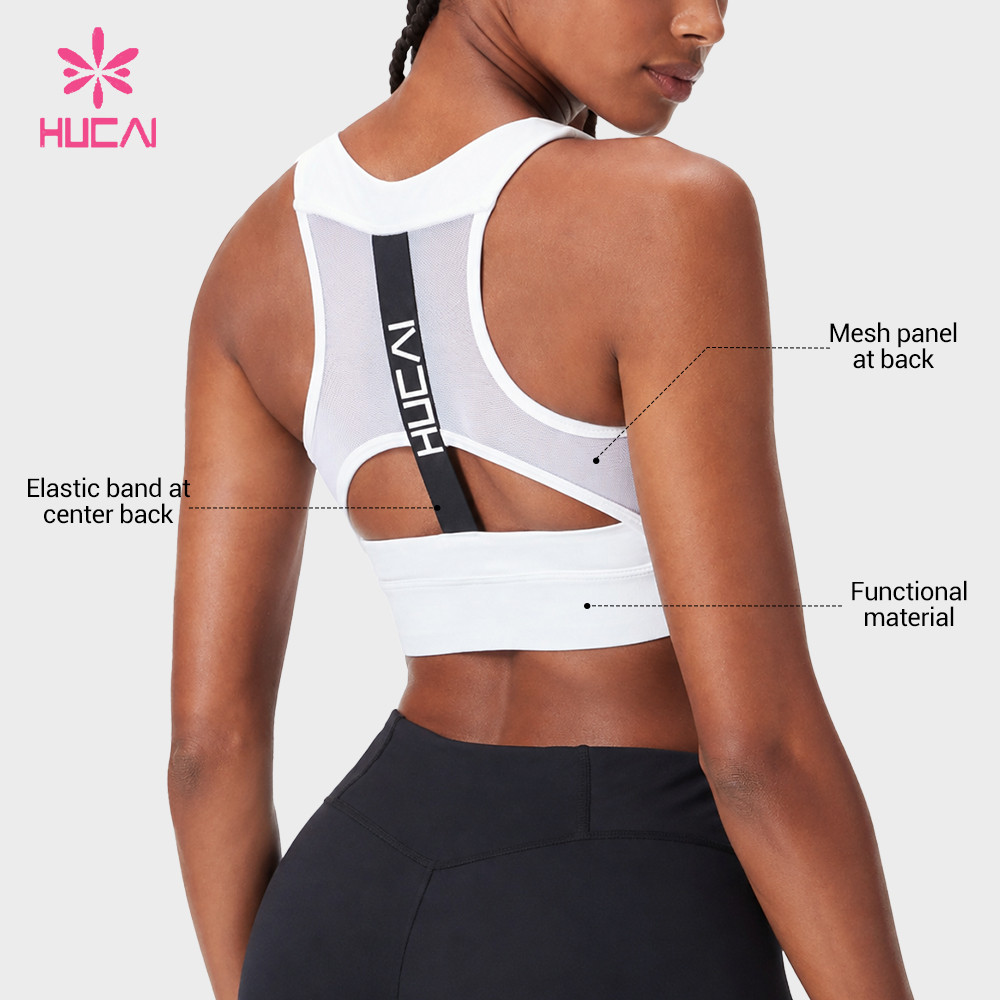
| Centre-back yoke | High: upper back heats first | Low to medium: away from arm movement | Moderate: clear the shoulder blade |
| Side bodice under armhole | High | Medium: edge can roll | Moderate: own grain and notch |
| Midriff band | Medium | Low at rest, medium in rotation | Low: must not shorten the body |
| Front chest below neckline | Medium | High: neckline lift | High: curved, high tension |
| Neckline or armhole edge | Low as ventilation | Highest: the edge is the load path | Highest: finish and allowance |
The back yoke is the most forgiving insert because the seam follows the body rather than fighting it. A side bodice panel works next, provided the grain is set before cutting.
Front chest mesh is where problems start. The panel crosses the bust, meets the neckline binding at a tight radius and shares space with the cup seam, so extension difference concentrates there. The custom tank top range shows comparable panel arrangements.
3. Matching Mesh to Shell
Two swatches that look compatible can behave differently at twenty per cent extension. Pair them by measured behaviour, not colour card or hand feel.
| Mesh option | Ventilation | Edge stability | Most suitable position | Main risk |
|---|---|---|---|---|
| Power or high-elasticity mesh | High open area | Medium: needs a stabilised seam | Side bodice, midriff | Extends beyond the shell, so the join waves |
| Jacquard or textured mesh | Medium | Higher: denser structure | Back yoke | Firmer hand, heavier seam |
| Bubble or raised mesh | Medium to high | Medium | Back and side panels | Bulk at the join |
| Laser perforation in the shell | Medium | High: panel is the shell | Any stable area | Only suits clean-cutting fabrics |
Cut strips of mesh and shell to the same width, apply the same load and record extension and recovery. Methods such as ASTM D2594 or ASTM D4964 make the comparison repeatable, and the figures belong in the tech pack.
Set a working limit before sampling. As a proposed starting point, a mesh extending beyond fifteen to twenty per cent more than the shell at the same load needs a shorter panel, a different mesh or a stabilised seam. Confirm it on the selected fabric; it is a development decision, not a test result. HUCAI Sportswear reviews extension, recovery and edge behaviour during fabric selection.

4. Neckline and Armhole Adjacency
Gaping complaints point at the neckline, but the cause is usually the nearest join. An insert meeting a neckline at a tight radius leaves the binding little fabric to hold, so extension difference concentrates in that corner.
The finish decides how much the edge recovers. A bound edge stabilises well but has less give; a folded edge gives the cleanest surface but needs a stable knit; tape controls extension but adds a line. On mesh, the finish must also stop the open knit curling.
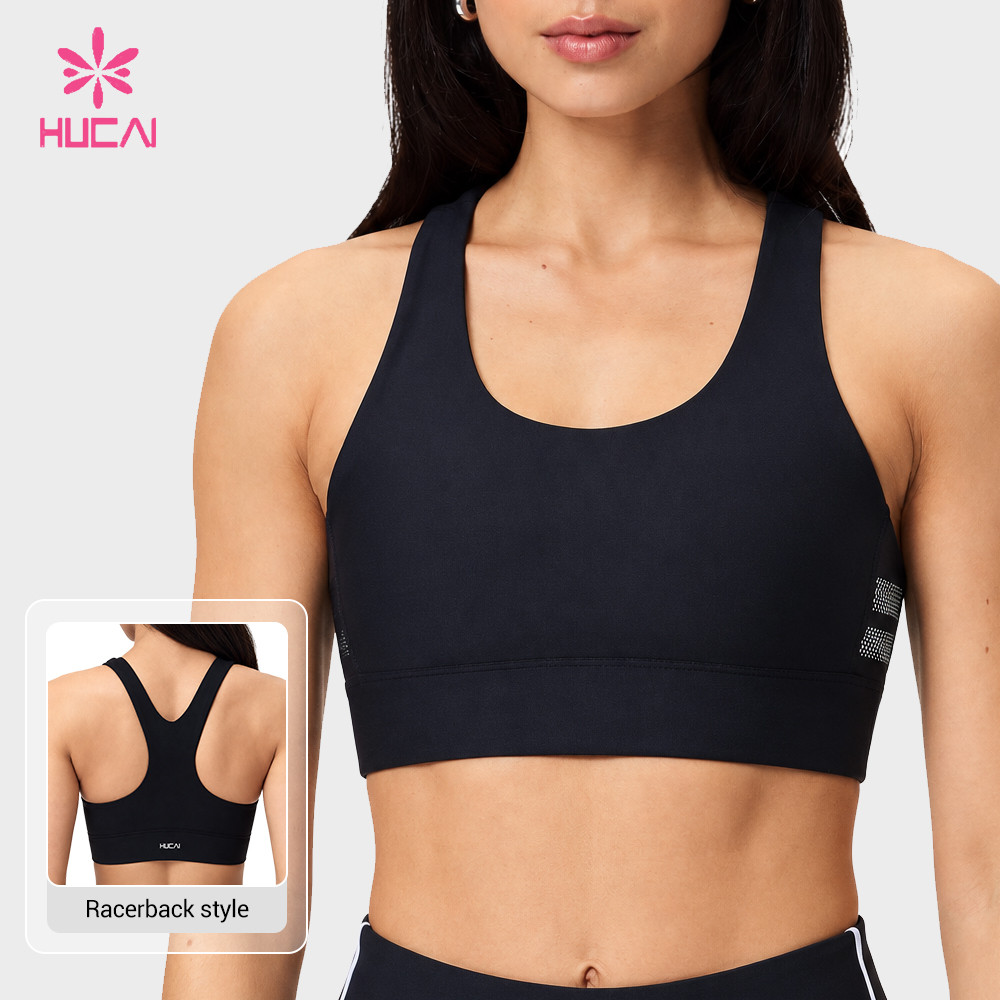
Strap junctions deserve their own review. A racerback carries load from the strap into the bodice, so a panel under that path is pulled diagonally rather than vertically. Panels drafted as a rectangle and set into a curved armhole produce the wave that appears only when the arm lifts. The bra-tank construction notes cover the neckline logic underneath.

5. Sample Checks
A mesh insert cannot be approved from a flat measurement. Review in a fixed order: flat, at rest, in movement, after washing. Record the gap at three marked points so a revision cites a number.
| Check | How to test | Proposed pass condition |
|---|---|---|
| Static neckline and join | Flat, then on model standing | Edge flat, no lift at centre front |
| Arm raise | Arms overhead, five seconds, three times | Lift inside the agreed allowance; no roll |
| Forward flexion | Reach toward the floor, three times | Edge stays in contact at the armhole |
| Torso rotation | Forty-five degrees each side | Join straight, no diagonal wave |
| Extension match | Strip test, same load | Difference inside the tech-pack limit |
| Wash and re-measure | Wash to care instruction, dry flat | Creep inside allowance; no curl |
Keep the fit model's measurements with dated photographs. HUCAI Sportswear runs this sequence inside its sample development process, so a revision names the check that failed.
6. Bulk Control and RFQ Inputs
Once approved, the sample becomes the standard for the join. Bulk drift shows up in alignment, cut direction, seam allowance and mesh shade. Alignment is checked against the approved sample, because a few millimetres change how the neckline sits. Cut direction belongs in the workmanship record: an off-grain panel measures correctly on the table and recovers differently in wear. HUCAI Sportswear applies AQL 2.5-based checkpoints in a staged workflow, described on the site's quality control standards page.
An RFQ here is a placement brief, not a price request. The fields that change the outcome are:
- Position: which of the five, finished dimensions, and the join line on a sketch.
- Direction and finish: mesh grain, and the finish at insert, neckline and armhole.
- Pairing: extension and recovery for both materials, plus the shade reference.
- Size range: base size, grade rule, and the sizes where the join may lift.
- Commercial frame: colour count, quantity and market.
Decision Check: Is This Insert Ready for Sampling?
Confirm the following before requesting a sample:
- Position: the insert sits in one of the five positions, with the join drawn.
- Pairing: extension and recovery figures exist for both materials.
- Intake: the allowance that absorbs the difference is defined.
- Finish: neckline, armhole and insert joins decided together.
- Record: movement and wash checks, three points and the fit model.
With three or more confirmed, the direction is ready for a sample request; with fewer, planning before cutting costs less than revising.
Next step: buyers with a tech pack can send it for OEM review before sampling. Buyers working from references can share them for ODM development, where position, mesh direction and edge finish are clarified first.
Founder's Technical Insight: Jean Yuan's Development Note
Most mesh-insert problems I see are drafted in, not sewn in. A reference shows a panel running from the underarm into the neckline, so it is drawn as a flat band, cut on the shell's grain, and expected to lie still. On the body that band stretches around the bust and must then hold at the neckline, so the join takes the load.
The fix is unglamorous. At HUCAI Sportswear we measure extension on both materials, shorten the panel to match, and set an intake so the seam absorbs what is left. Then we test three sizes in a forward bend, because a panel that holds at the base size often lifts two sizes up. If it still stands away, the placement is wrong, not the sewing.
FAQ
Where is a mesh insert least likely to gape?
The centre-back yoke is the most stable position, followed by the side bodice under the armhole. Both keep the join away from the neckline, where load directions meet.
How much stretch difference between mesh and shell is acceptable?
There is no universal figure. Measure both at the same load and set the limit in the tech pack; a proposed limit is fifteen to twenty per cent.
Can a mesh insert be added to an existing pattern?
Yes, but it is a pattern change, not a trim addition. The join needs its own allowance and intake, and the edge finish may need re-specifying.
Why does the neckline lift when mesh is inserted at the chest?
The mesh extends further than the shell and the neckline is the nearest release point. Shortening the panel or stabilising the seam addresses the cause; tightening the neckline does not.
Does a mesh insert automatically make a top cooler?
No. Airflow depends on open area, yarn structure, layer count and panel size. A small panel over a high-load area can add a seam without changing much airflow.
What is the MOQ for a private label mesh-insert top?
The current public MOQ starts from 100 pcs per style; colour count, size range and mesh selection are confirmed per project.
Final Takeaway
A mesh insert is approved by its position and its join, not by how open the knit looks. Put the panel where the shell can carry the load, match the materials by measured extension, give the seam an intake, and test the edge in movement and after washing. If those points are missing from the tech pack, plan a specification round before sampling.
About HUCAI Sportswear
- Founded in 1998, manufacturing women's activewear in Dongguan, China
- OEM and ODM development across bras, leggings, tops and sets
- Fabric, trim, pattern and sample review before bulk, with AQL 2.5-based inspection
Current certification information can be reviewed during supplier evaluation based on the project and documentation requirements.