
Heat-Printed Leggings: How to Control Stretch Distortion and Print Registration
Heat transfer is the route many brands choose when a printed motif should sit on the fabric rather than be knitted into it. Casall's AW26 New In listing, published on the brand's own site in November 2026, includes heat printed high waist tights in two zebra colorways — a Nordic benchmark treating a printed surface as a core tight. On a stretch legging, the print becomes a second material with its own behaviour: it resists extension, holds heat, and changes the geometry of the motif once the garment is worn. What fails is rarely the artwork. It fails when the motif stretches with the body, drifts off the seam it was aligned to, or changes scale between sizes, which is why HUCAI Sportswear reviews printed leggings at pattern stage, before film and coverage are signed off.
Quick Answer
Stretch distortion and registration are decided before the press, not after it. Engineer the motif onto the pattern, compare the film's elongation with the shell's extension at hip and knee, write tolerances to seams and artwork, then hold those numbers through wash checks and bulk sampling.
Table of Contents
- Who This Article Is For
- What a Buyer Is Actually Approving
- Where Distortion Comes From
- Two Registration Tolerances Buyers Merge
- Four Print Routes and Their Trade-offs
- Sample Acceptance Checks You Can Measure
- Bulk Control and RFQ Inputs
- Decision Check
- Founder's Technical Insight (Jean Yuan)
- FAQ
- Final Takeaway
Who This Article Is For
- Primary reader: brand founders and sourcing managers building a printed leggings style.
- Secondary reader: technical designers and pattern makers who own the placement card.
- Product stage: artwork and shell are shortlisted; samples not approved.
- Problem: the print passed flat but distorts at the hip, drifts at the side seam, or reads differently in bulk.
- Not needed for: knit-in jacquard or yarn-dyed structures with no transfer film.
What you gain: two registration tolerances in millimetres, a sample acceptance table for your tech pack, and the bulk records that keep a printed legging consistent.
What a Buyer Is Actually Approving
Heat transfer printing uses a pre-printed film carrying the motif in reverse, bonded by heat, pressure and dwell. Unlike sublimation, where dye enters polyester fibre, a transfer adds a second material with its own mechanical behaviour on a knit that extends and recovers.
Approval covers three things, and buyers usually sign only the first: motif geometry flat, motif geometry under extension, and bond durability after washing. A strike-off on a rigid board proves neither of the last two. For method and cost comparison, see integrating print and pattern into activewear production.

Where Distortion Comes From
Distortion is a mismatch problem, not an artwork problem. The shell extends at the hip and knee in wear; the film extends far less, so the motif absorbs the difference unevenly: thin lines thicken, dots turn oval, dense edges lift first. Coverage and placement decide how badly, because the same motif across a hip point behaves differently from one on the lower thigh.
The responses are unglamorous: keep dense artwork out of the highest extension zone, split the motif at panel boundaries, compare film elongation with the shell's target, and allow for press relaxation. Recovery logic is in fabric recovery testing before sampling.

Two Registration Tolerances Buyers Merge
Registration describes two relationships, and merging them in a tech pack is a common reason a printed style is rejected.
Print to print
Colour-to-colour alignment inside the motif. A single-pass film locks it. Risk appears when two films are pressed in sequence: both carry their own placement, and about plus or minus 1.5 to 2 mm at the motif edge is a workable start.
Print to garment
Motif position against side seam, waistband edge, knee line or gusset. Parts move between cutting, pressing and sewing, so this belongs on a placement card per landmark: about plus or minus 3 mm relaxed after 24 hours, referenced to pattern notches.
Scale across sizes is the forgotten third. A motif can hold a fixed size or grade with the pattern: fixed keeps film cost stable but changes proportion, graded protects proportion and adds artwork per size. Record the choice before the grade rule is issued, since it affects leggings development cost.
Four Print Routes and Their Trade-offs
The route decides most registration risk before a sample is cut.
| Route | Suits | Registration, stretch and trade-off |
|---|---|---|
| Engineered placement print on cut panels | Large graphics, seam-critical placement | Strongest position control; extra pressing per part, cut-edge distortion if pressed before sewing |
| All-over print on yardage, then cut | Dense repeats, small-scale patterns | Lower unit cost at volume; repeat must meet at seams, position shifts at every size |
| Placement graphic on a solid base | Logos, small hip or chest graphics | Tight position control, little extension exposure; can read as branding, not print |
| Printed panel joined to solid or mesh | Two-surface looks, engineered blocking | Join line is the critical tolerance; two materials recover at different rates |
All-over yardage is chosen for cost, yet seam matching can consume that saving on small orders with large repeats. The printed-panel route fails most often because the join is measured across two materials that move differently.
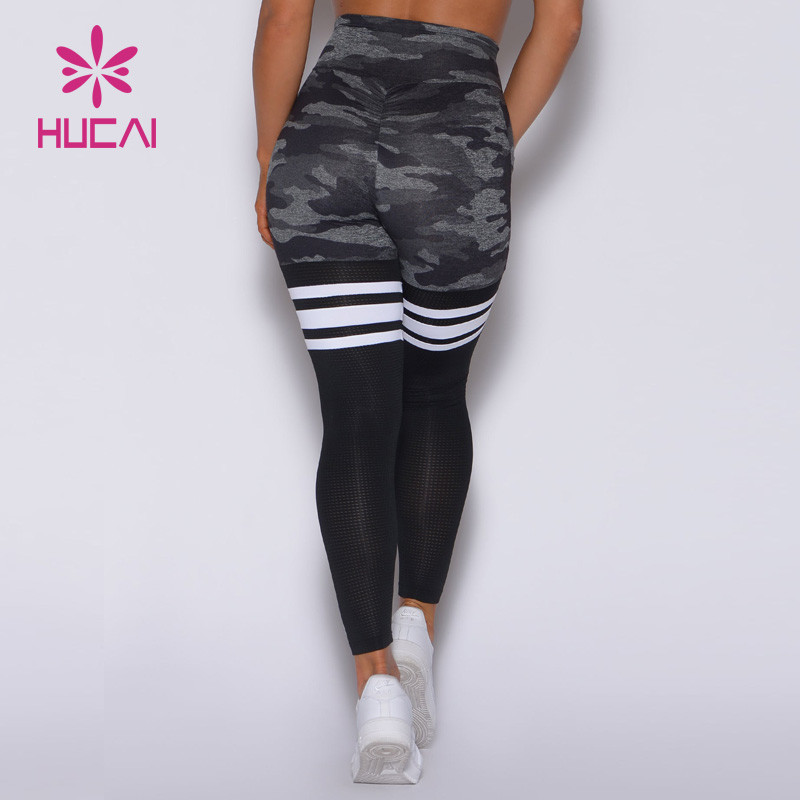
Send the placement intent with the artwork: a tech pack naming the landmark, tolerance and measurement size removes most sample-stage guesswork. Buyers can send a tech pack for OEM review with grade rule and placement card, and HUCAI Sportswear will check the card against the pattern before film is ordered.
Sample Acceptance Checks You Can Measure
These are proposed criteria for a sample review, not laboratory results. Confirm them with the film supplier against the actual shell.
| Check | Method | Proposed acceptance, to confirm |
|---|---|---|
| Motif position to landmark | Three notched points, garment relaxed 24 hours | Plus or minus 3 mm per landmark |
| Motif scale against artwork | Measure one fixed dimension, such as a repeat block | Within plus or minus 2 percent |
| Distortion under extension | Extend to 30 and 50 percent, hold 30 seconds, remeasure | Growth within 3 percent at 30 percent extension; recovery within 2 percent after 60 seconds |
| Bond after laundering | Three washes at 30 degrees per care label | No edge lift above 1 mm, no visible cracking at 300 mm |
| Colour change after washing | Grey scale, ISO 105-C06 style protocol | Change at least grade 4, staining grade 3-4 or better |
| Rubbing transfer | ISO 105-X12 style crocking check, dry and wet | At least grade 4 dry, grade 3-4 or better wet |
Two disciplines make the table usable. Measure relaxed only, since a panel pulled flat passes checks it should fail, and record which size was measured. Sampling typically runs about 10-15 days once artwork, shell and placement are confirmed; the sample policy sets out what the buyer supplies.

Bulk Control and RFQ Inputs
After pre-production approval, most bulk problems trace back to three records never kept: press parameters, film lot, and first-off approval per lay. Keep a transfer log per film lot, approve a first-off pair against the sealed sample before each lay, and put a registration gauge at the inspection table. HUCAI Sportswear applies AQL 2.5-based inspection inside a workflow combining pre-production review, in-process checkpoints and pre-shipment inspection, with print measurements written into it.
An RFQ that includes seven items usually reaches a usable first sample:
- Artwork and intent: print-ready files, colour references, placement, panel or all-over repeat.
- Placement card: the landmarks the motif must respect, with the tolerance at each.
- Size range and grade rule: sizes to grade, plus the fixed or graded scale decision.
- Shell specification: composition direction, weight, stretch and recovery targets.
- Extension expectation: where the print sits relative to hip, knee and gusset.
- Wash and market: care label intention, destination market, test protocol.
- Volume: quantity per colour, print colourway count, packaging.
Sequencing is in the production procedures overview. Bulk production often runs about 25-30 days after approvals, depending on print route and quantity.
Decision Check: Is This Printed Leggings Direction Ready for Sampling?
Before requesting samples, confirm the following:
- Motif on the pattern: artwork placed on pattern pieces, crossings named.
- Extension zones flagged: hip, knee flex and gusset marked on the card.
- Film and shell compared: film elongation checked against the shell's target.
- Tolerances written: print-to-print and print-to-garment limits per landmark.
- Scale recorded: fixed or graded motif scale confirmed for the size range.
If four or more are confirmed, the direction is ready for a sample request.
Founder's Technical Insight: Jean Yuan's Development Note
In HUCAI Sportswear's sample room, the printed leggings problem that repeats most is not colour. It is timing. A cut panel comes off the press, looks correct, is measured immediately, and passes. Twenty-four hours later it has settled, the motif has moved a millimetre or two against the notch, and the first-off pair no longer matches what the inspector approved.
Our response is boring on purpose. We press a test swatch of the actual shell before approving the film, and read extension at the hip. Cut parts rest before position is measured, and the placement card states the relaxed state so nobody measures a warm panel.
FAQ
What is the difference between heat printing and sublimation on leggings?
Heat transfer bonds a pre-printed film onto the fabric surface; sublimation turns disperse dye into gas that enters polyester fibre. A transfer gives sharper edges but adds a layer with its own stretch behaviour and a bond that can lift.
Can a heat-printed motif stretch with a four-way stretch legging?
It stretches, but usually less than the shell. Where that gap is large at the hip or knee, distortion shows as thickened lines, oval dots and edge lift, so coverage is reduced or the motif split at a panel boundary.
What registration tolerance should I specify for printed leggings?
Two numbers: about plus or minus 1.5 to 2 mm at the motif edge for print-to-print on a two-film design, and about plus or minus 3 mm per landmark for print-to-garment, measured relaxed after 24 hours.
Why does a printed motif look different between sample and bulk?
Usually the film lot, press parameters or the shell lot's extension behaviour changed. A signed reference panel per film lot and a transfer log per run make it visible before shipment.
Which wash test applies to heat-printed activewear?
Brands commonly reference an ISO 105-C06 style wash protocol for colour change and an ISO 105-X12 style crocking check, plus a visual bond check for edge lift. Agree method and pass grade with the film supplier.
Should a print be pressed on cut panels or on yardage?
Cut panels give stronger position control and allow alignment to a seam, at the cost of extra handling and cut-edge distortion. Yardage printing is cheaper at volume, but the repeat must meet at seams and can waste fabric.
What is the MOQ for heat-printed leggings?
The current public MOQ starts from 100 pcs per style. Final colour, size, fabric, film and print-colour planning depends on the confirmed project.
Final Takeaway
A heat-printed legging is approved on three layers: the motif on the pattern, the motif under extension, and the bond after washing. The figures that decide bulk consistency are small — a few millimetres at a landmark, a couple of percent in scale — and easier to write into a card than to argue at inspection.
Next step: buyers shaping a print story can start ODM development from reference images and confirm film, coverage and placement before sampling.
About HUCAI Sportswear
- Founded in 1998, making women's activewear in Humen, Dongguan, China
- OEM and ODM development across bras, leggings, shorts, tops and sets
- Fabric and trim review, pattern and CAD support, sample development
- Quality workflow with pre-production review, AQL 2.5-based inspection and consistency control
Current certification information can be reviewed during supplier evaluation based on the project and documentation requirements.